
1 / 3
On this page
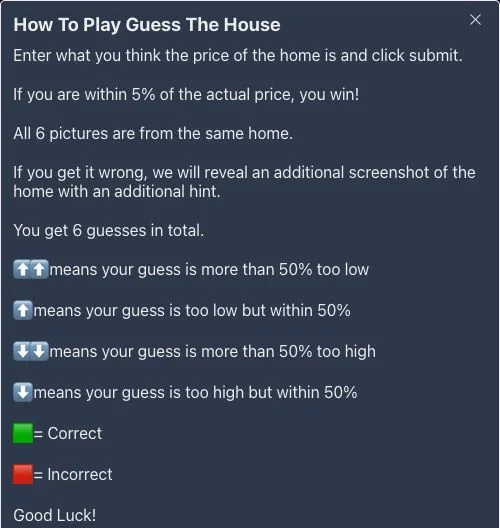
Guess The House asks you to estimate a property's price from photographs. You have six guesses, but winning does not require the exact dollar amount: an estimate within 5% counts. That tolerance makes it a test of market judgment rather than a search for a precise listing number.
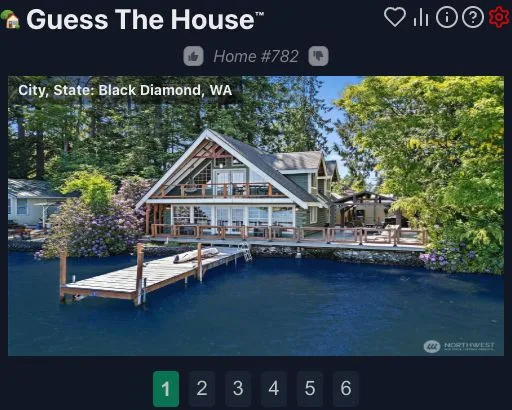
The opening photo gives you something concrete to inspect before committing. Location matters alongside the building itself. A house that looks modest in one market may be expensive in another, so read the displayed city and state before deciding what the architecture seems worth.
What happens after a guess
Type a price into the visible field and submit it. In our unaided daily test, the first estimate landed inside the winning range and produced “You Nailed it.” We therefore tested the successful submission directly; the miss sequence below comes from the game's Help rather than a failed attempt of our own.
According to that Help, an incorrect estimate reveals another photograph and a hint. All six pictures show the same property. Treat the new picture as information about the home you are already valuing, rather than as a new round. An interior can change your reading of condition or finish, while an exterior may clarify what the first angle concealed.
The arrows describe both direction and rough scale of error. An upward arrow means your estimate is low; a downward arrow means it is high. Double arrows indicate that the estimate is more than 50% off in that direction. Single arrows narrow that broad warning, but they still do not identify an exact price.
Use the hints to narrow a range
A practical approach is to keep a rough price interval in mind. If the feedback says “too low,” move the lower end of that interval rather than making another almost identical guess. A double arrow is a reason to reconsider the scale of the estimate. A single arrow calls for a more measured adjustment.
The 5% allowance also changes the last step. Once the pictures and directional feedback point toward a narrow range, you are aiming to enter that winning band. Chasing an exact-looking number adds precision that the rules do not require.
This advice follows the displayed rules; our one-guess win did not test every arrow or later photo unlock. We have kept the current property's answer out of this page and selected images.
Daily puzzle and previous homes
The current daily home is free. The Previous Days screen we inspected displayed a premium-membership requirement for the archive, so older homes should not be presented as unrestricted free practice. We did not purchase membership or test a paid archive puzzle.
Guess The House suits players who enjoy looking closely at property photos and making an estimate with incomplete information. Its useful tension is deciding how much weight to give the location, appearance and next hint. Even a successful guess leaves room to compare your initial impression with what the photographs actually showed.
FAQ about Guess The House
Do I need the exact price?
No. The Help says an estimate within 5% of the price wins.
What do double arrows mean?
They indicate that your estimate is more than 50% too low or too high, depending on the direction.
Are previous homes free?
The Previous Days screen displayed a premium-membership requirement. The current daily home remains free.
Player reviews
0 reviewsPlayed it? Share what you think and help the next player choose.
Your experience
Games like Guess The House
All estimation games →
Roam
EstimationAnswer seven numerical questions while a pixel knight travels on your score. Roam gives 30 seconds per estimate, proportional scoring and repeatable category runs.

Cars
EstimationEstimate real auction-car sale prices against a short countdown. Photos, mileage, mechanical details and auction context help you set a price before the result is revealed.

Poured
EstimationPredict the level reached when a drink moves into a different vessel, then account for ice, foam and leaks in three daily pours.

Weigh Ahead
EstimationName something just heavier, lighter, newer or less populous in seven timed comparisons, then turn the closeness of your answers into a balloon flight from London.

Range Squeeze
EstimationChoose numerical bounds for seven daily trivia answers. Tight ranges offer more points, but a single number outside your interval scores zero.

Overunderle
EstimationEstimate a number, then decide whether the answer is over or under your guess across five daily Overunderle questions.