


1 / 3
On this page
Cars on Dialed asks what a real auction vehicle sold for. You get photographs and a compact listing card, then choose a dollar amount before a short countdown runs out. The answer is the price of that particular car in that particular sale, so model recognition is a starting point rather than the whole solution.
The main menu offers Singleplayer, Multiplayer, Daily and High Scores. We tested Singleplayer, including a manually locked estimate and its revealed sale result. The competitive and daily modes were visible but were not completed in this session.
Read the listing while the timer runs
Each singleplayer game has five rounds. The rounds we opened used a 20-second timer, with photographs changing while the listing remained available. Next Photo lets you inspect another view without waiting for the automatic change.
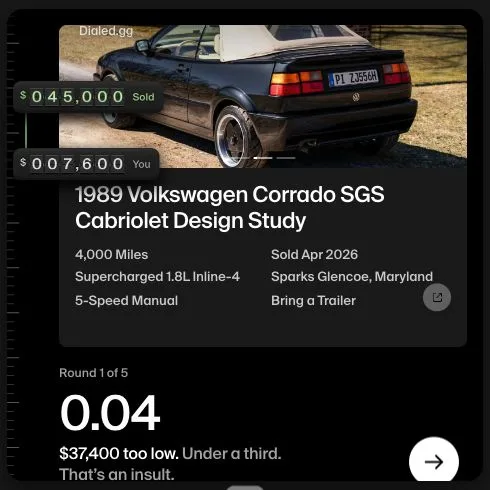
The card names the year and model, then supplies details such as mileage, engine and transmission. It also identifies the sale date, location and auction house. Those details are useful because two cars carrying the same model badge can reach very different auction prices.
Look at the units as well as the numbers: our rounds included mileage stated in miles on one car and kilometres on another. Special editions, modifications and auction context can also appear in the text. With a short timer, identify the strongest few price signals before making a large slider adjustment.
Set a price and commit it
Move the price control, then use the lock control to submit. We restarted a singleplayer game and adjusted a Volkswagen estimate from $7,500 to $7,600 with the slider's keyboard input before locking it. The sale result was $45,000, leaving our estimate $37,400 too low and awarding 0.04 out of 10 for the round.
The low score made the error easy to understand: the game displayed both amounts and the difference instead of only a failure label. A link to the Bring a Trailer sale was also available on that result. We then advanced to the next car rather than completing all five rounds.
An earlier timed-out round also revealed the sold price. Do not rely on that as a substitute for choosing an estimate: a round with no submitted guess earned zero in our test. Locking a deliberate value is the action to practise.
Learn from the gap between model and sale
The result provides a useful comparison for another attempt. Ask which listing details could explain the difference between your expectation and the auction outcome. A distinctive conversion, condition, provenance or market context may matter more than recognising the base model.
Singleplayer could be started again from the menu without registration. The site also displayed an optional paid ad-free offer, so the available basic game should be distinguished from that subscription. We did not verify a historical archive or the daily reset timezone.
The gallery shows a singleplayer price-setting card and a separate result. It uses faithful rectangular crops of the game card to leave surrounding advertisements out of the images. Cars works best as a quick appraisal exercise: read the actual vehicle details, commit an estimate and use the revealed sale to question the assumptions behind it.
FAQ about Cars
Am I guessing the original retail price?
No. The round asks what that particular auction car sold for. Use its condition, mileage and auction context rather than only the model name.
How long do I have to choose a price?
The singleplayer rounds we tested used a 20-second countdown. Set the slider and lock the price before it expires.
What does the result show?
It reveals the sale price, your estimate, how much too high or low you were and a round score out of ten. A source-auction link was available on our tested result.
Player reviews
0 reviewsPlayed it? Share what you think and help the next player choose.
Your experience
Games like Cars
All estimation games →
Roam
EstimationAnswer seven numerical questions while a pixel knight travels on your score. Roam gives 30 seconds per estimate, proportional scoring and repeatable category runs.

Poured
EstimationPredict the level reached when a drink moves into a different vessel, then account for ice, foam and leaks in three daily pours.

Weigh Ahead
EstimationName something just heavier, lighter, newer or less populous in seven timed comparisons, then turn the closeness of your answers into a balloon flight from London.

Range Squeeze
EstimationChoose numerical bounds for seven daily trivia answers. Tight ranges offer more points, but a single number outside your interval scores zero.

Overunderle
EstimationEstimate a number, then decide whether the answer is over or under your guess across five daily Overunderle questions.

Dartle
EstimationChoose answers whose numerical values add toward 100, using at most three darts. Stand early to keep a safe total, or risk a bust; some daily categories offer exact-100 redemption.