
1 / 3
On this page
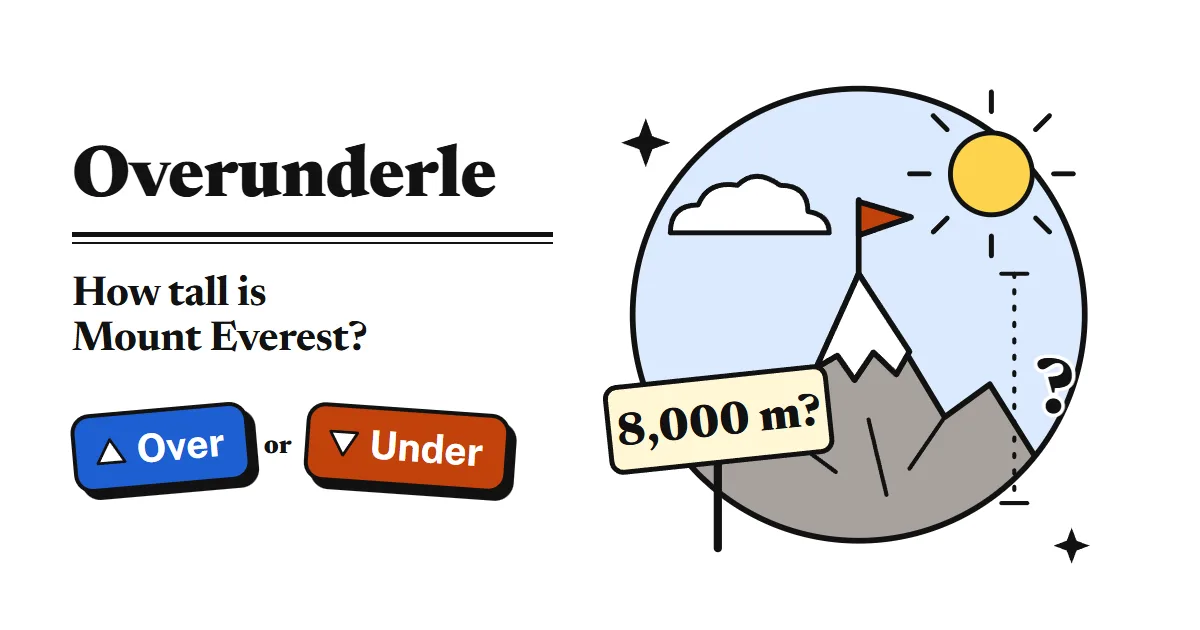
Overunderle turns each trivia question into two decisions. First, type your numerical estimate. Then choose whether the real answer is over or under that estimate. A close guess earns points on its own; the second decision gives you a chance to improve that score without changing the number you submitted.
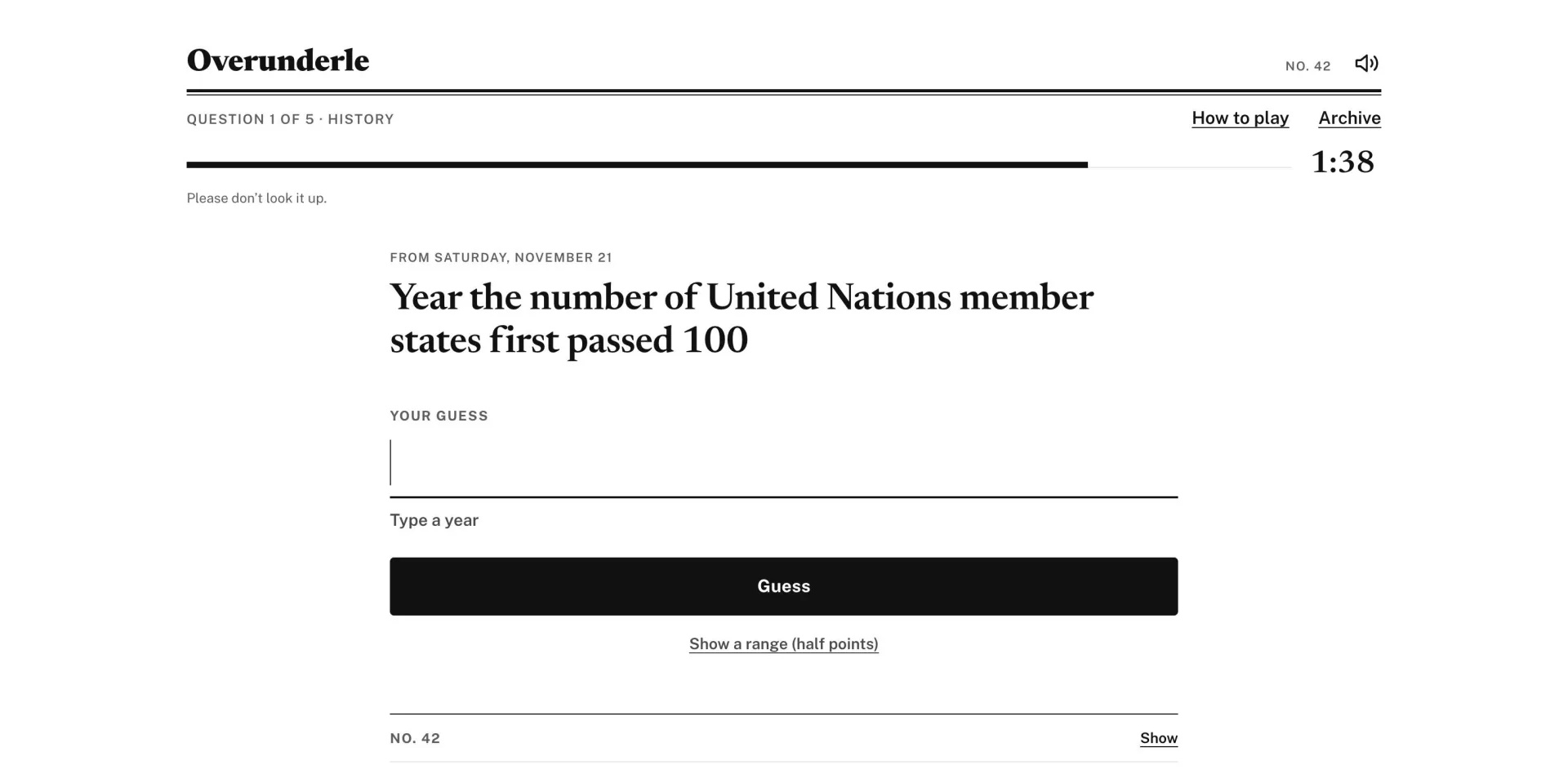
A daily game has five questions. Each question has a two-minute timer, so there is a practical limit to how long you can search your memory or reconsider a unit. The topics in our session ranged across population, geography, employment and time. Knowing the rough scale of an answer often matters before knowing its exact value.
Commit to a number, then choose a direction
Read the unit before typing. A question about a year needs a year; a population percentage needs a percentage. Once the estimate is submitted, the over-or-under decision asks where the answer lies relative to that specific number.
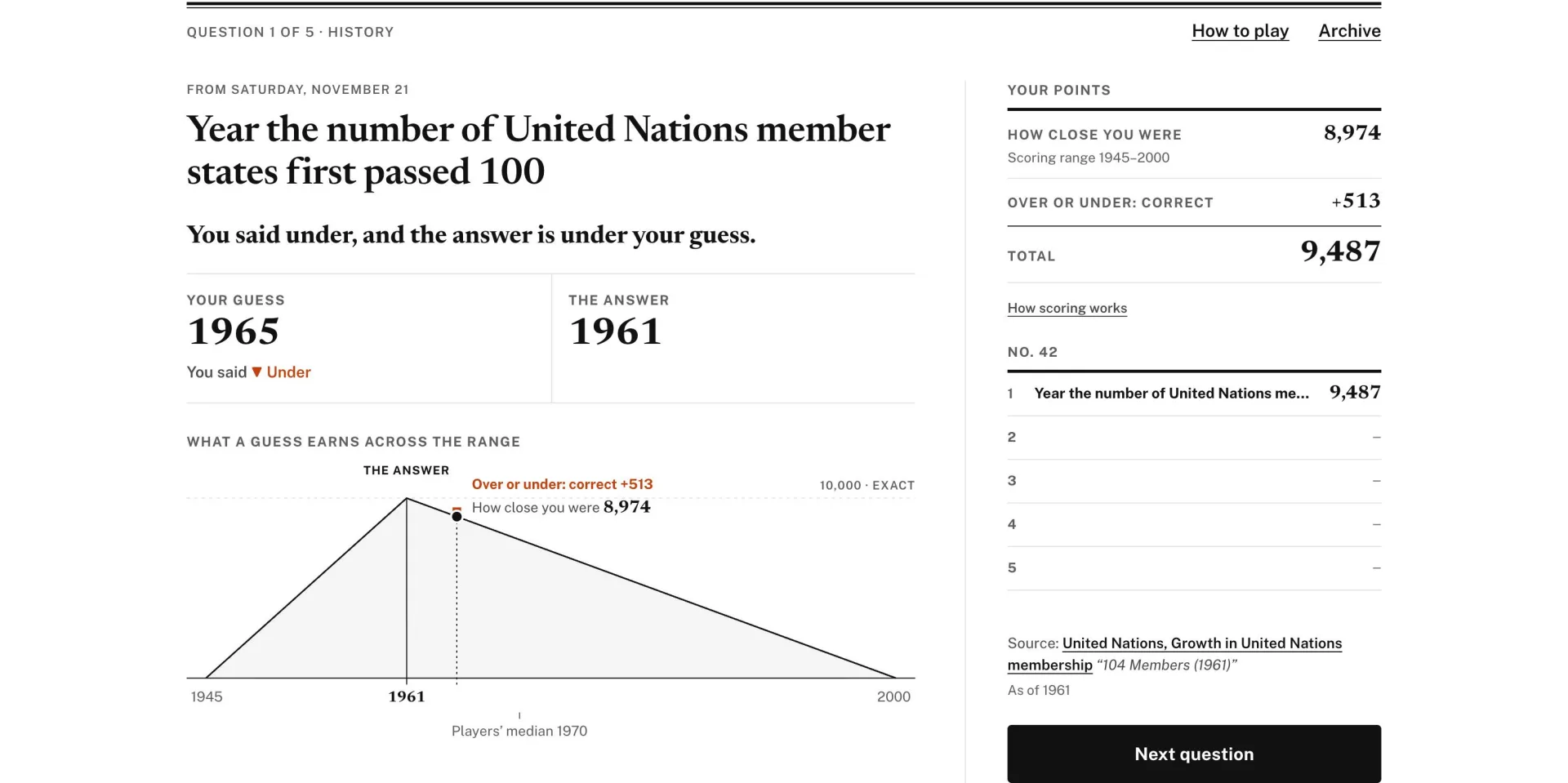
We tested this full sequence unaided in the daily game and then opened a dated archive round for public screenshots. In that historical question, a guess of 1965 followed by Under was compared with an answer of 1961. The estimate earned 8,974 points and the correct direction added 513, producing 9,487 for the question.
That result shows why the second choice deserves its own thought. You can be close enough to earn a strong base score and still need to decide which side of your estimate is more likely. In the daily test, the timer also expired while a direction decision was still pending. Entering a number does not remove the need to watch the clock.
How proximity and bonuses interact
The official scoring explanation gives an exact answer 10,000 points. An inexact guess within the question's sensible range receives a proximity score from 1 to 9,999; guesses outside that range receive zero base points.
A correct over-or-under choice adds half the gap between the base score and 10,000. A wrong choice leaves the base score unchanged. In the archive example, the gap above 8,974 was 1,026, so the direction bonus was 513. This is a bonus on top of the numerical estimate, rather than a replacement for it.
There is also a range hint. According to the scoring page, using it halves the base score and limits the bonus ceiling to 5,000. We opened the hint control but did not complete a hinted attempt, so that penalty is an official rule rather than a measured result from our session. Consider the tradeoff before taking it: the extra guidance comes with a lower scoring ceiling.
Practice with a dated game
The calendar archive lets you select earlier dates. We opened the November 21 game, started it without an account and completed its first question through the score breakdown. This provides practice on a past set without needing to wait for the next daily questions.
The calendar and question screen make the selected date visible. Check that date when comparing results with someone else, especially if one player has opened an archive entry. The official scoring page confirms five fresh questions daily, but our research did not establish an official reset timezone or hour.
FAQ about Overunderle
Can I change my estimate after choosing over or under?
The tested sequence submits the estimate first and then asks for a direction. Choose the number you want to commit to before submitting it.
Does a wrong direction remove my base points?
No. The official scoring page says a wrong over-or-under choice leaves the base score unchanged.
What is the cost of a range hint?
The official scoring explanation says it halves the base score and reduces the bonus ceiling to 5,000.
Can I play an older set?
Yes. The calendar archive opens dated past games; we started and played a historical question without registering.
Player reviews
0 reviewsPlayed it? Share what you think and help the next player choose.
Your experience
Games like Overunderle
All estimation games →
Roam
EstimationAnswer seven numerical questions while a pixel knight travels on your score. Roam gives 30 seconds per estimate, proportional scoring and repeatable category runs.

Cars
EstimationEstimate real auction-car sale prices against a short countdown. Photos, mileage, mechanical details and auction context help you set a price before the result is revealed.

Poured
EstimationPredict the level reached when a drink moves into a different vessel, then account for ice, foam and leaks in three daily pours.

Weigh Ahead
EstimationName something just heavier, lighter, newer or less populous in seven timed comparisons, then turn the closeness of your answers into a balloon flight from London.

Range Squeeze
EstimationChoose numerical bounds for seven daily trivia answers. Tight ranges offer more points, but a single number outside your interval scores zero.

Dartle
EstimationChoose answers whose numerical values add toward 100, using at most three darts. Stand early to keep a safe total, or risk a bust; some daily categories offer exact-100 redemption.