


1 / 3
On this page
Roam turns numerical estimation into a journey for a pixel knight. Each question asks for a quantity, from an everyday fact to a topic-specific number. Choose an estimate before the timer ends, then watch the score determine how far the knight progresses.
The daily challenge has seven questions worth up to 100 points each. You do not need an exact answer to earn something, but you do need to submit: an unanswered countdown can end with zero.
One estimate in thirty seconds
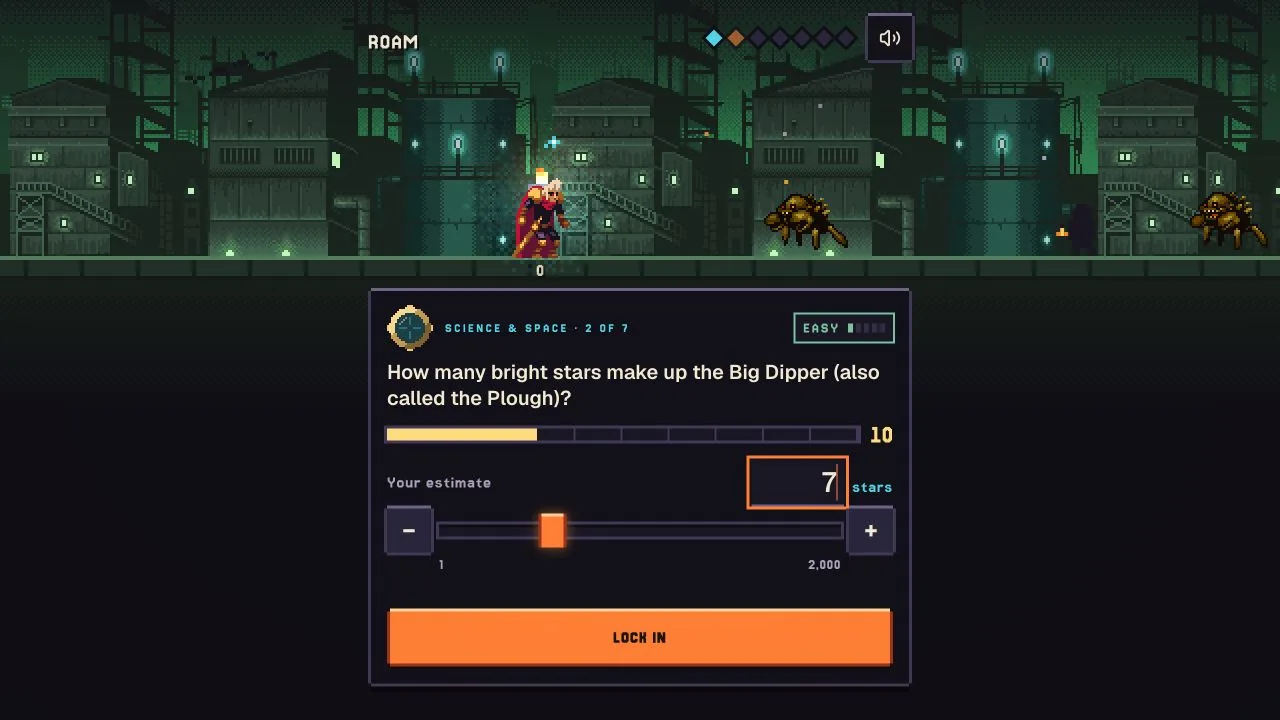
A question appears above a numerical input and slider. Type a value directly or adjust the control, then press Lock In. The help gives each question 30 seconds and one committed estimate, so you cannot keep revising after seeing the answer.
Pay attention to the requested unit. The useful estimate is the number the question asks for, not a related figure remembered in another unit or on another scale. Use the timer to decide whether the answer is likely to be in the tens, thousands or much larger before refining it.
We entered the daily challenge and submitted its first numerical answer, receiving 100 points. We then checked a separate Science and Space category run rather than completing the daily set. Its first question timed out without a submitted estimate and earned zero; on the next, we typed an exact answer, locked it and received 100 points.
These are tested round results, not a completed seven-question score. The category images show the input and feedback stages without revealing a full current daily set.
Closeness is proportional
The rules compare estimates proportionally. Being twice the answer and being half the answer count as comparable errors. A tenfold error scores zero, while a precise answer can earn the full 100 points. This is a reason to think in ratios rather than only in the absolute difference between two numbers.
For a very large quantity, an error of a few hundred may be small; for a quantity in single digits, it would be enormous. Before locking an uncertain answer, check that its order of magnitude fits the question. Narrowing a huge range can be more useful than adding a false sense of precision to a poor starting estimate.
After submission, Roam displays the answer and points, with a source link on the results we inspected. The knight's progress gives the score a visible consequence, and the help describes reaching new lands as points accumulate.
Daily and topic runs
The game explicitly sets the daily reset at midnight UTC, or 08:00 in Beijing. That is a global reset rather than an assumed midnight in your browser's timezone.
Categories can be played repeatedly and let you focus on a subject. We opened Science and Space through that area and exercised its timed input and scoring. Endless and a friends challenge were also advertised, but their full rules were not tested here.
Basic play did not ask us to register. We did not establish a historical archive or a complete pricing policy. To get a useful run from Roam, make a reasoned estimate, lock it before time expires and compare the revealed number with the scale you expected. The next question gives you another chance to calibrate that judgement.
FAQ about Roam
Does a timeout submit the number currently in the box?
Do not count on it. The help says an unsubmitted timeout earns zero, and our first category question timed out for zero. Use Lock In before the countdown ends.
Is being twice too high worse than being half too low?
The rules use proportional closeness, treating those errors comparably. A tenfold error earns zero, while an exact answer can earn 100 points.
When does the daily challenge reset?
The game explicitly states 00:00 UTC, which is 08:00 in Beijing.
Can I keep playing after the daily?
The Categories area offers repeatable topic games. We entered Science and Space and tested its estimate and result controls; the menu also advertises Endless.
Player reviews
0 reviewsPlayed it? Share what you think and help the next player choose.
Your experience
Games like Roam
All estimation games →
Cars
EstimationEstimate real auction-car sale prices against a short countdown. Photos, mileage, mechanical details and auction context help you set a price before the result is revealed.

Poured
EstimationPredict the level reached when a drink moves into a different vessel, then account for ice, foam and leaks in three daily pours.

Weigh Ahead
EstimationName something just heavier, lighter, newer or less populous in seven timed comparisons, then turn the closeness of your answers into a balloon flight from London.

Range Squeeze
EstimationChoose numerical bounds for seven daily trivia answers. Tight ranges offer more points, but a single number outside your interval scores zero.

Overunderle
EstimationEstimate a number, then decide whether the answer is over or under your guess across five daily Overunderle questions.

Dartle
EstimationChoose answers whose numerical values add toward 100, using at most three darts. Stand early to keep a safe total, or risk a bust; some daily categories offer exact-100 redemption.