



1 / 4
VideoOn this page
Gazillion asks you to put two boundaries around a historical event. You choose an earliest and latest date, then lock in the range before the timer runs out. A narrow window can earn more points, but it also gives you less room for an uncertain memory. The timeline stretches from the Big Bang to today, so choosing the right scale matters as much as remembering a year.
Put boundaries around what you know
The yellow handles mark the ends of your guess. The interface also offers Type years, with separate FROM and TO fields and date-unit selectors. We used those fields during our desktop test; the visible choices included AD, BC, Kyrs, Myrs and Byrs. That matters when a question moves from recent entertainment to the formation of the solar system. We did not test submissions with every unit or assess dragging precision.
Our first Infinite guess enclosed a modern event in a three-year window and earned 975 points with PERFECT feedback. You can leave some room around a date without needing to submit one exact year; this result does not establish a best range for every question. The official in-game instructions describe a maximum of 1,000 points per moment, with tighter successful ranges earning more.
Points can still cost a life
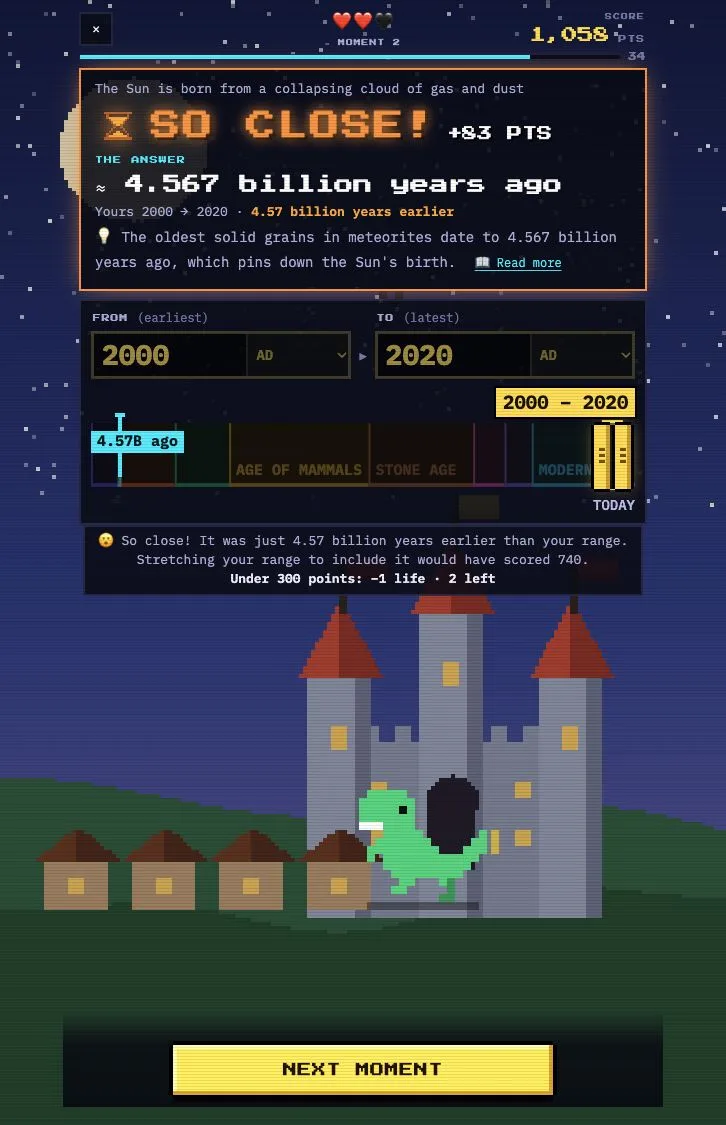
Infinite starts with three lives. In our run, a result below 300 points removed one life, even when the guess earned some points. Three deliberately poor guesses ended the run after four moments, at a settled total of 1,073. Those misses tested the feedback and failure condition; the total is not a measure of typical difficulty.
This makes “I earned something” a different outcome from “I kept my life.” When you cannot place an event confidently, allowing more uncertainty in your range is a reasonable choice to consider. We have not measured an optimal width or verified a universal near-miss scoring formula.
Read the feedback before moving on
The result screen places the answer alongside your selected interval, awards points and states any life penalty. One of our misses also explained how many points a range stretched to include the answer would have earned. You can see the consequence of the interval you chose, rather than only a correct-or-incorrect label.
The screen also displayed a short historical explanation and a Read more link. We observed those elements but did not independently fact-check the linked historical accounts. The selected feedback screenshot comes from Infinite; we did not start the current Daily puzzle.
Daily has a different stopping point
The official About panel describes Daily as five shared moments with one attempt per day, while Infinite continues until three lives are lost. We completed the Infinite loop only. The same panel advertises new moments at midnight without identifying a reset timezone, so a specific local reset time is not confirmed here.
FAQ about Gazillion
Do I have to enter the exact year?
No. You submit a range with an earliest and latest date. The official instructions award up to 1,000 points per moment and reward tighter successful ranges; our three-year interval earned 975.
Why did I lose an Infinite life after earning points?
A score below 300 costs one life in Infinite. We observed this with an 83-point result, so earning partial points does not necessarily preserve a life.
Can I type dates instead of dragging the timeline?
Yes. Type years exposes separate FROM and TO inputs with date-unit selectors. AD, BC, Kyrs, Myrs and Byrs were visible; we tested modern AD submissions, not every ancient-date unit.
Does everyone get the same Daily moments?
Yes. The official About panel describes five shared Daily moments and one attempt per day. It says new moments arrive at midnight but does not name a timezone. Daily itself was not part of our completed Infinite test.
Player reviews
0 reviewsPlayed it? Share what you think and help the next player choose.
Your experience
Games like Gazillion
All estimation games →
Roam
EstimationAnswer seven numerical questions while a pixel knight travels on your score. Roam gives 30 seconds per estimate, proportional scoring and repeatable category runs.

Cars
EstimationEstimate real auction-car sale prices against a short countdown. Photos, mileage, mechanical details and auction context help you set a price before the result is revealed.

Poured
EstimationPredict the level reached when a drink moves into a different vessel, then account for ice, foam and leaks in three daily pours.

Weigh Ahead
EstimationName something just heavier, lighter, newer or less populous in seven timed comparisons, then turn the closeness of your answers into a balloon flight from London.

Chronophoto
HistoryEstimate the year of a historical photograph, submit the year and compare it with the dated result across a five-round session.

Range Squeeze
EstimationChoose numerical bounds for seven daily trivia answers. Tight ranges offer more points, but a single number outside your interval scores zero.