
1 / 4
Videos · 2On this page
Chronophoto shows a photograph and asks which year it was taken. Your evidence is inside the image: clothing, technology, vehicles, buildings and other details that may help distinguish one period from another. A year estimate becomes a score only after you submit it.
The result exposes the size of the miss
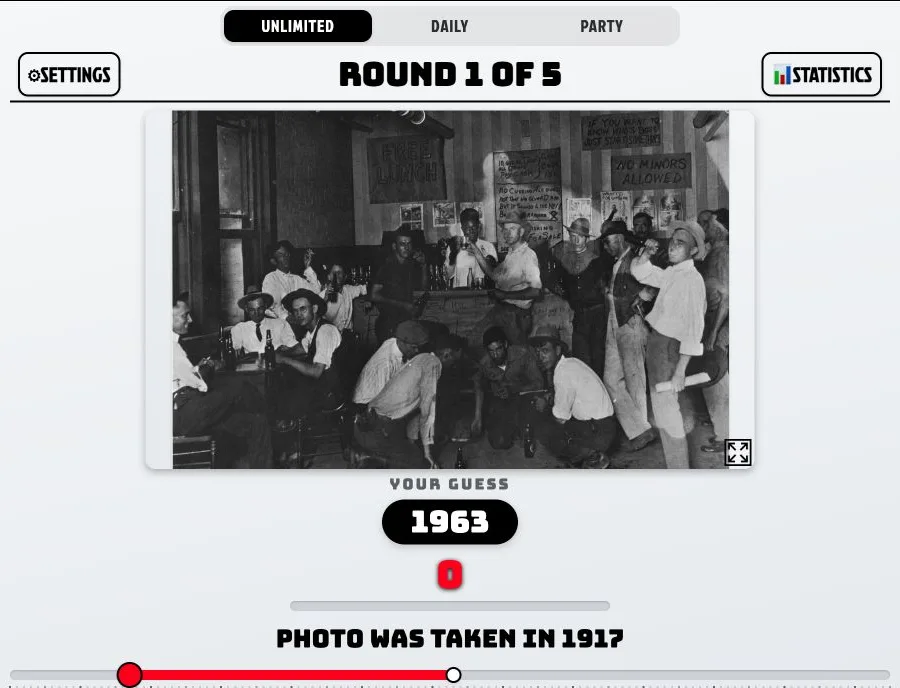
We used Unlimited for the hands-on test. Its interface labeled the session Round 1 of 5 and presented a black-and-white interior photograph with people and signs. We submitted the displayed year, 1963, without consulting an answer. The result reported that the photograph was taken in 1917 and awarded 0 points, with a total of 0.
Those dates belong to our Unlimited round, not the current daily challenge. The screenshot deliberately uses that separate session. We did not complete the five rounds or verify a final results screen.
The result view placed the guessed and reported years on a timeline and offered Next Round. That made the error visible as a range, rather than leaving us with only a numerical score. The test does not establish the complete points formula or the maximum available score.
Use details to narrow a period
The official About page describes recognizing history through clues such as fashion, technology and popular culture. A useful approach is to identify a plausible era first, then examine details that could move the estimate earlier or later within it.
That is advice about reading the photograph, not a verified method for scoring highly. A black-and-white image alone does not provide a precise year, and our large miss shows the limits of the single estimate we made. We have not independently authenticated the source photograph or its reported date.
The photo area also has a full-screen control. We observed the control but did not test a separate full-screen session or mobile gestures.
Choose the session before comparing results
The current navigation separates Unlimited, Daily and Party. Our observations concern Unlimited; they do not establish Party rules or whether all modes use identical scoring and photographs. Match a walkthrough to its mode before expecting to see the same image.
The About page acknowledges that photo dates can be mistaken and provides a contact route. If a historical detail appears inconsistent with the stated year, treat that as something to investigate rather than silently rewriting the game’s displayed result.
FAQ about Chronophoto
Is Unlimited separate from Daily?
Yes. The navigation offers separate Unlimited and Daily entries. Our test used Unlimited, labeled Round 1 of 5; we did not complete all five rounds.
How did the game respond to a distant year guess?
Our 1963 estimate was compared with a reported 1917 date and scored 0 points. We did not verify the full scoring formula.
Can the reported photo date be wrong?
The official About page acknowledges possible dating mistakes and provides a contact route. We did not independently authenticate the photograph used in our test.
Player reviews
0 reviewsPlayed it? Share what you think and help the next player choose.
Your experience
Games like Chronophoto
All history games →
WhereTaken
GeographyIdentify a country from a photograph, then use distance, direction and proximity feedback to narrow six guesses.

Framed
Movies & TVUse successive film stills to identify one movie, with six attempts and a new frame after a wrong guess or skip.

Wikitrivia
HistoryInsert historical event cards into a growing timeline, with three mistakes available and links to the underlying Wikidata and Wikipedia records.

GeoHistory
GeographyPlace five historical answers on a globe. Distance-based scores and fixed question multipliers turn each daily round into a 1,000-point geography challenge.

Gazillion
EstimationBracket historical events between two dates, balance a tighter range against uncertainty, and keep three lives in Infinite or tackle five shared Daily moments.

Chrono
HistoryArrange six historical events in chronological order, then submit the timeline and use the remaining attempts to revise it.