
1 / 3
On this page
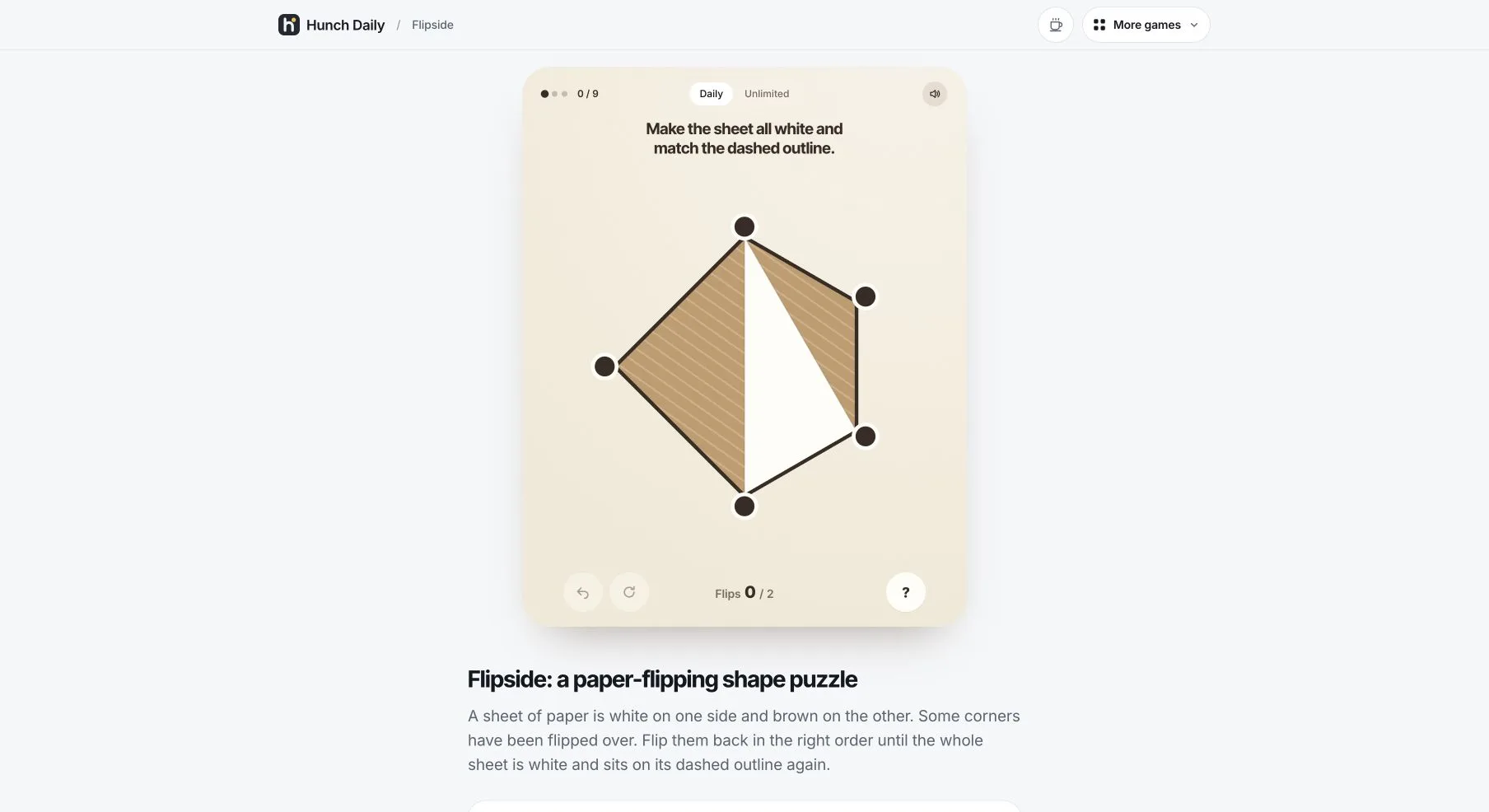
Flipside turns a sheet of two-coloured paper into a question about sequence. Some corners have been turned over, exposing the brown underside. Flip them back until the entire sheet is white and its outline matches the dashed target. The complication is that a corner flip can change the outline as well as the colour: the next move may happen on a differently shaped sheet.
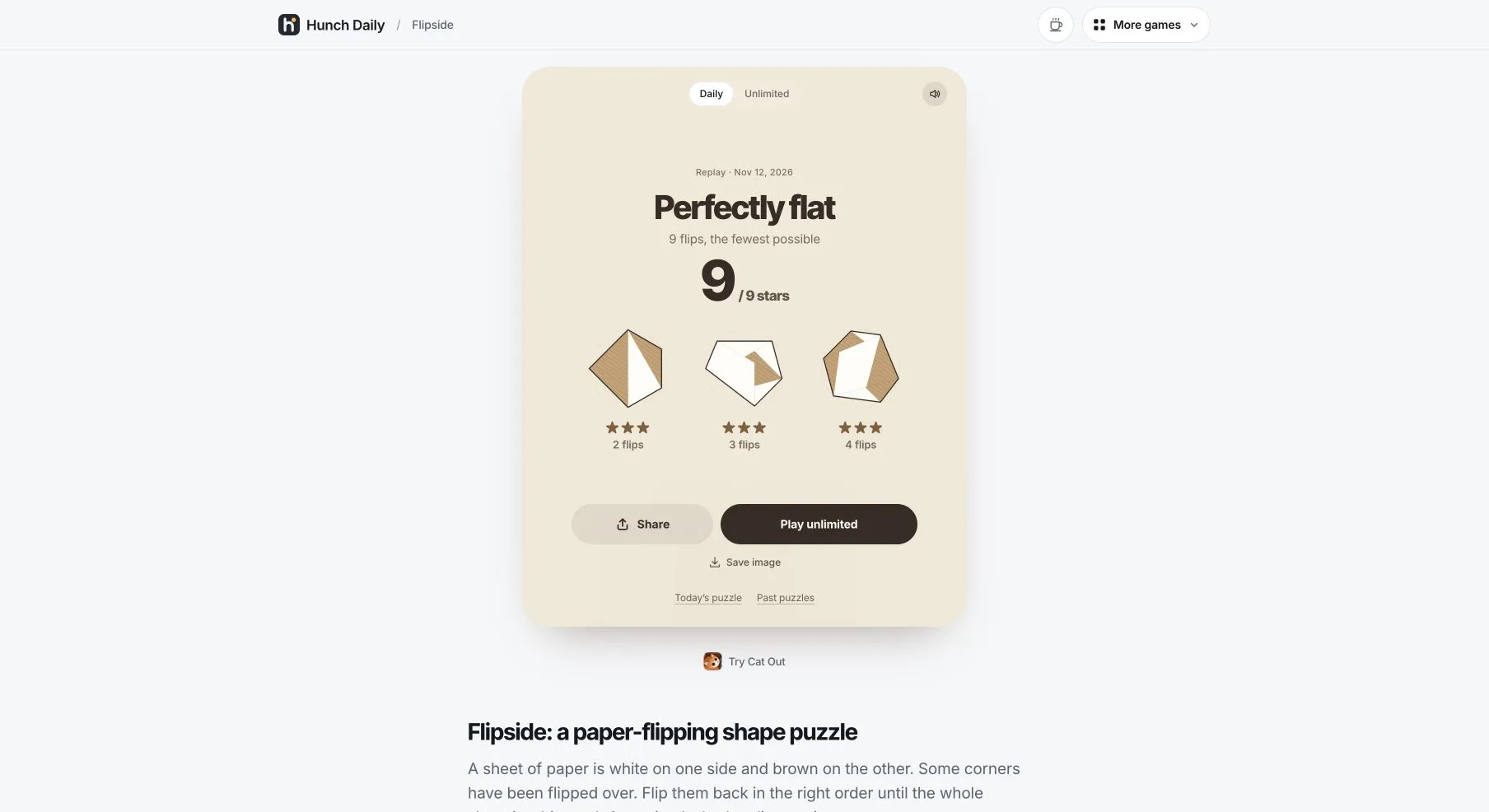
We completed the three sheets in the November 12 daily replay in two, three and four flips. The result screen confirmed nine flips in total, the fewest possible, and nine stars. Getting there involved an undone move on the second sheet and a restart on the third. Those recoveries made the game’s central demand clear: finding corners that need attention is only half the puzzle; arranging their flips is the other half.
Look at the outline as well as the brown side
A corner folds along the line between its neighbours. According to the on-page rules, unequal adjacent edges swap when it flips, so the corner can move. That is why blindly tapping the same screen position is unreliable. Follow the new vertices after each fold, and compare the resulting silhouette with the target.
The goal is an all-white sheet in the target shape. Rotation is accepted, but a reflected version is not. This distinction matters when an almost correct outline seems to fit only after mentally turning the paper over. You may rotate your interpretation of the target; you cannot treat its mirror image as equivalent.
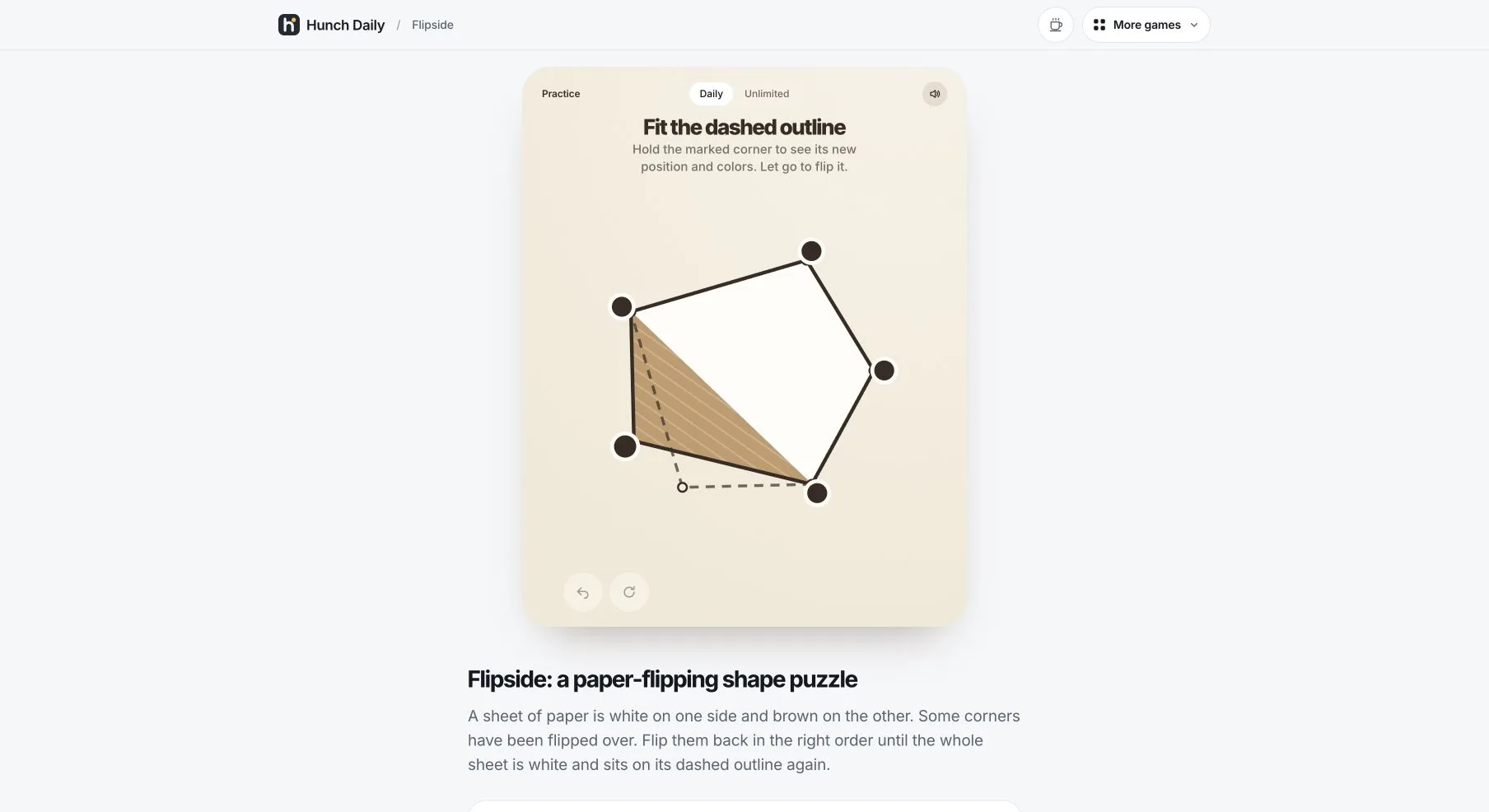
The rules also describe a free preview: hold a corner to inspect its proposed shape and colours, release to commit, or slide away to cancel. That is useful for checking what a fold will do before spending it. Our completed run used direct corner selections rather than relying on this preview.
Plan an order, then use the recovery tools
An isolated brown corner is an obvious place to investigate, but neighbouring folds can affect one another. The official tips explain that adjacent overlapping flips are order-dependent, while non-adjacent flips commute. In play, a plausible opening on the final sheet left us with an unhelpful arrangement after two moves. Restart restored the starting paper and a zero flip count, letting us test a different order.
Undo also behaved as a practical planning tool in Daily: taking back an exploratory move on the second sheet returned its counter from one flip to zero. Use that feedback to compare a sequence against the minimum shown after the slash. A sheet solved efficiently is more satisfying than a quick string of taps that leaves the outline harder to read.
Three daily sheets, with a score for efficiency
Daily supplies three sheets of increasing difficulty. An optimal solution earns three stars on a sheet; the rules allow two extra flips for two stars, and award one star for any completed solution. There are no Daily hints. The three-sheet format gave our session a clear finish, and the final panel listed each sheet’s flip count alongside its stars.
There is also an Unlimited mode, whose rules use spare flips and paid-in-spares hints. We did not test that mode, so the recovery behaviour described here applies to Daily. Flipside is a good fit for players who enjoy manipulating a small visual system, revising an order and watching why it works. Its challenge comes from tracking changes to the paper, rather than recognising a word or recalling a fact.
FAQ about Flipside
Does the target have to face exactly the same way?
No. The official rules accept rotations of the target shape, but a mirror image does not count.
Can I undo or restart without keeping the extra flips?
In our Daily run, Undo reduced the counter from one to zero and Restart restored the starting sheet with zero flips. Unlimited has different spare-flip rules.
How are Daily stars awarded?
Each of the three sheets gives three stars for the minimum flips, two for finishing within two extra flips, and one for any completed solution. The daily maximum is nine.
Can I check a fold before committing it?
The rules describe holding a corner to preview its shape and colours. Release to flip or slide away to cancel; the preview is free.
Player reviews
0 reviewsPlayed it? Share what you think and help the next player choose.
Your experience
Games like Flipside
All shapes & patterns games →
Marked
MemoryRemember briefly flashed target positions and replace them on a blank board, with distance feedback and more marks in each daily round.

Cutle
Shapes & PatternsCut a daily shape into two equal areas with one straight drag. Cutle records your first score, offers past shapes, and counts 48:52 or better as a win.

Geocrumble
GeographyRecognize three countries from separated map fragments. Wrong guesses join pieces and reveal more coastline, while continent feedback helps narrow the search and the score drops.

Loopy
Shapes & PatternsDraw a closed loop while reducing Loopy’s numbered clues to zero through nearby bends.

Draw a single river loop through every open square, working around walls and blocked spaces. Learn the controls in the tutorial or try the daily board.

Packline
Shapes & PatternsPartition a map with four-cell shapes and match the required district wins by counting population, not just colored cells.