
1 / 4
On this page
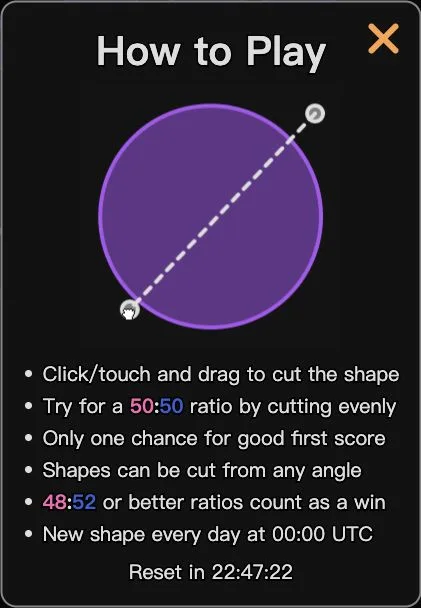
Cutle asks you to divide a shape into two equal areas with a single straight cut. Drag across the shape at any angle, release, and see how close the two pieces are to 50:50. A ratio of 48:52 or better counts as a win. The daily shape changes at 00:00 UTC.
Making your first cut
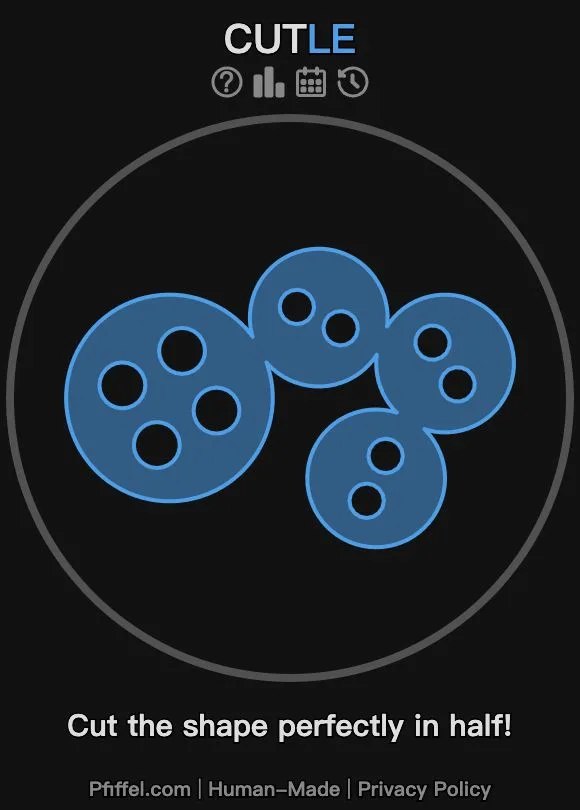
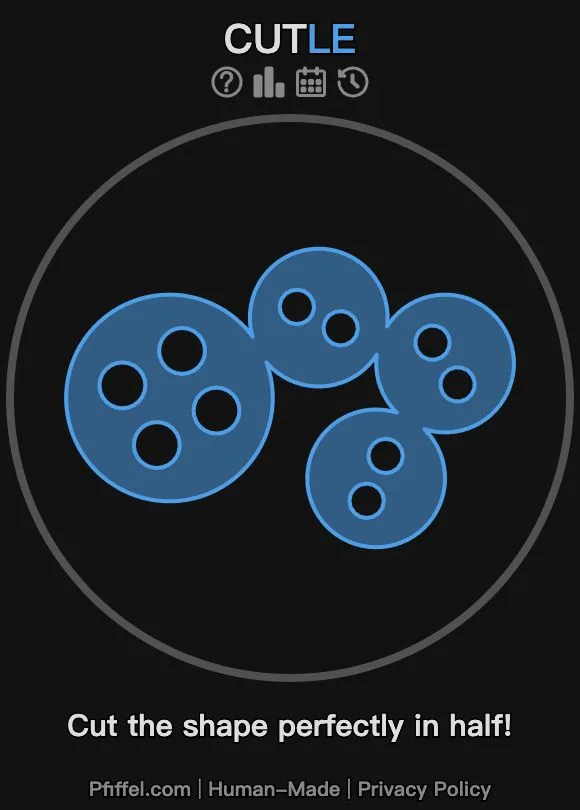
Take a moment to compare the areas on either side of your intended line. You are balancing filled space, so a shape with holes can be harder to judge than its outside outline suggests. The November 16 archive puzzle, for example, joined several button-like circles with holes through them. A horizontal line looked plausible in our test but produced 47:53, just outside the winning range.
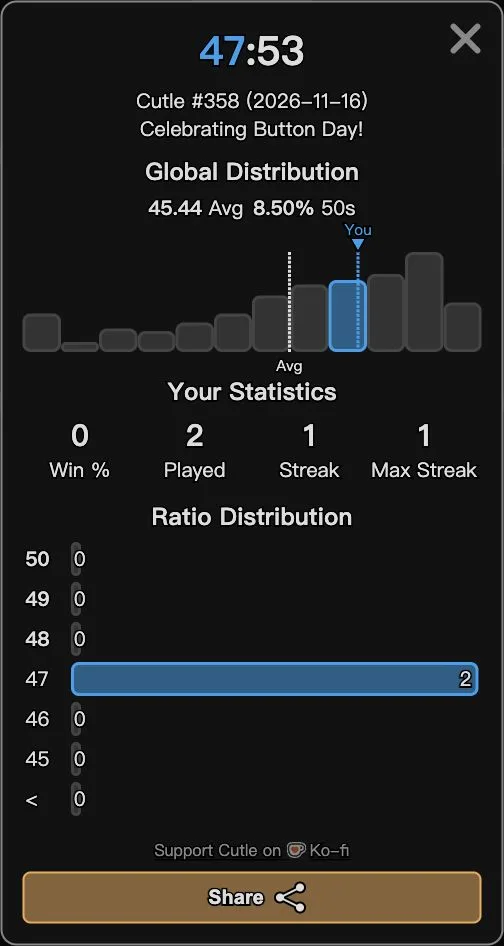
You can cut from any direction; there is no requirement to slice vertically or horizontally. Start the drag on one side of the shape and carry it across to the other. The result appears as a ratio, followed by a statistics panel with your score and a global distribution. Our current-day first attempt also finished at 47:53. Those two losses were enough to show how a small area imbalance matters here.
First scores and the archive
The first cut deserves care because Cutle distinguishes your first result from later practice. Its official update history says past shapes can be retried as often as you like, with the best score tracked separately. Repeated cuts of an old shape therefore offer practice without turning the original attempt into a fresh first score.
Open the calendar icon to choose an earlier shape. Selecting a date loads that puzzle and gives it a direct dated URL, which is useful if you want to discuss the same shape with someone else. We opened and completed the November 16 puzzle through this archive without creating an account. The developer states that the archive and future bonus content are intended to remain free, with optional support through Ko-fi.
Reading your result
The result panel separates the immediate cut ratio from your broader record. It shows win percentage, games played, current streak, maximum streak and a ratio distribution. The global chart puts your cut beside other submitted results for that shape. These comparisons can help you judge a near miss, but they do not provide a new first attempt.
A streak does not require a winning cut: the official history explicitly documents that change. Our test record showed a streak despite both cuts being outside the winning range. If your main goal is precision, watch the ratio and win record rather than treating the streak alone as proof of accurate cutting.
Cutle suits a brief visual estimation break, especially if you enjoy a decision that resolves in one movement. The main challenge is judging area before committing. The archive gives you room to practise that judgement after the daily first cut is recorded.
FAQ about Cutle
Does a Cutle streak mean every cut was a win?
No. The official update history says streaks do not require wins. The ratio and win percentage measure accuracy separately.
Can I practise old Cutle shapes?
Yes. Open the calendar to choose a past shape. The official history says retries of past shapes track a best score separately from the first score.
When does the next Cutle shape arrive?
The official help specifies a new shape every day at 00:00 UTC.
Player reviews
0 reviewsPlayed it? Share what you think and help the next player choose.
Your experience
Games like Cutle
All shapes & patterns games →
Marked
MemoryRemember briefly flashed target positions and replace them on a blank board, with distance feedback and more marks in each daily round.

Geocrumble
GeographyRecognize three countries from separated map fragments. Wrong guesses join pieces and reveal more coastline, while continent feedback helps narrow the search and the score drops.

Flipside
Shapes & PatternsFlip two-coloured paper into an all-white target shape, plan the order of neighbouring folds, and solve three daily sheets in as few moves as possible.

Loopy
Shapes & PatternsDraw a closed loop while reducing Loopy’s numbered clues to zero through nearby bends.

Draw a single river loop through every open square, working around walls and blocked spaces. Learn the controls in the tutorial or try the daily board.

Packline
Shapes & PatternsPartition a map with four-cell shapes and match the required district wins by counting population, not just colored cells.