
1 / 8
Videos · 2On this page
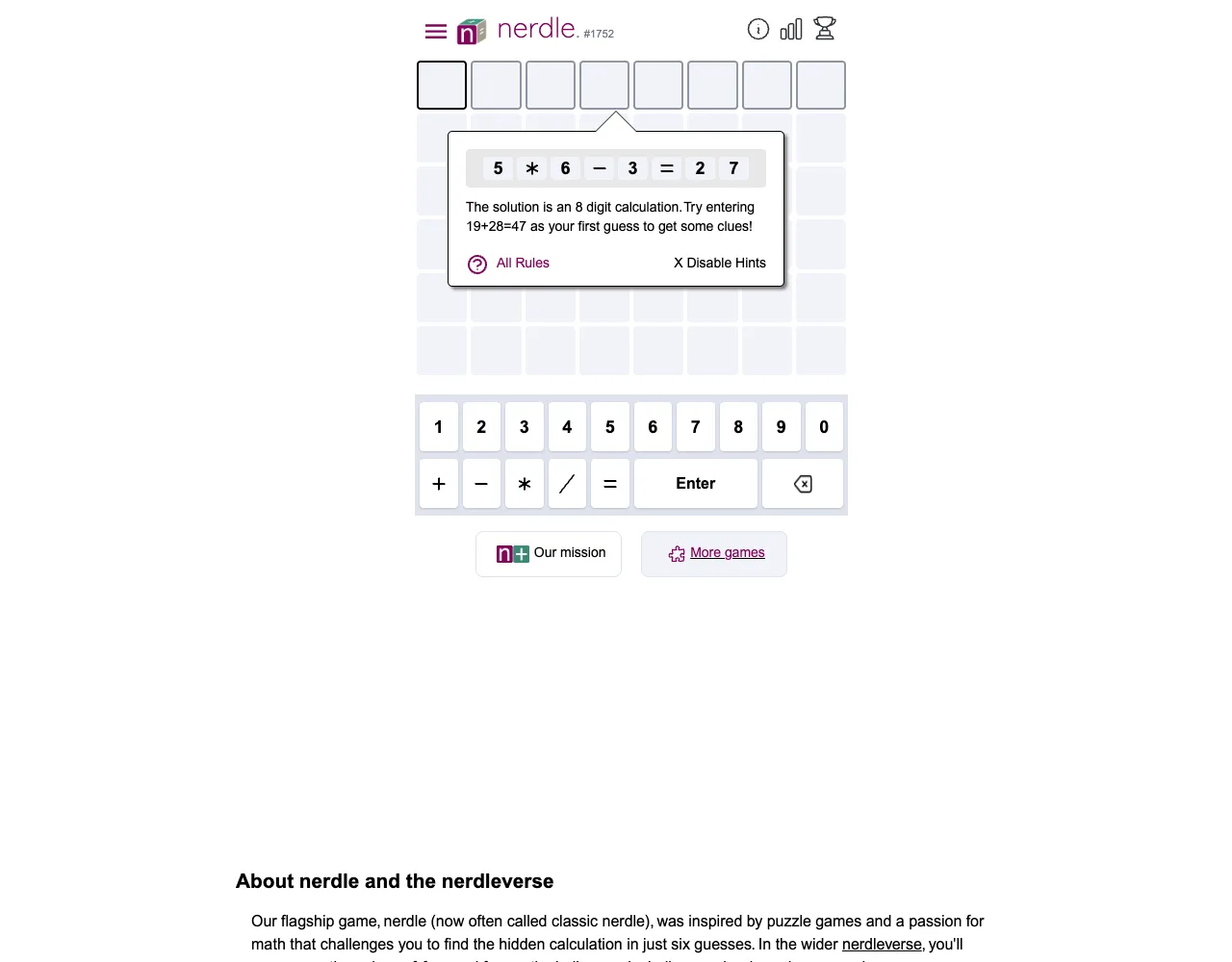
Nerdle requires two kinds of correctness. Each guess must be a valid calculation, and its 8 characters must help locate the hidden calculation within 6 attempts. A mathematically true equation can still be the wrong answer; a false equation is rejected before it becomes a scored row.
Check the arithmetic before the colors
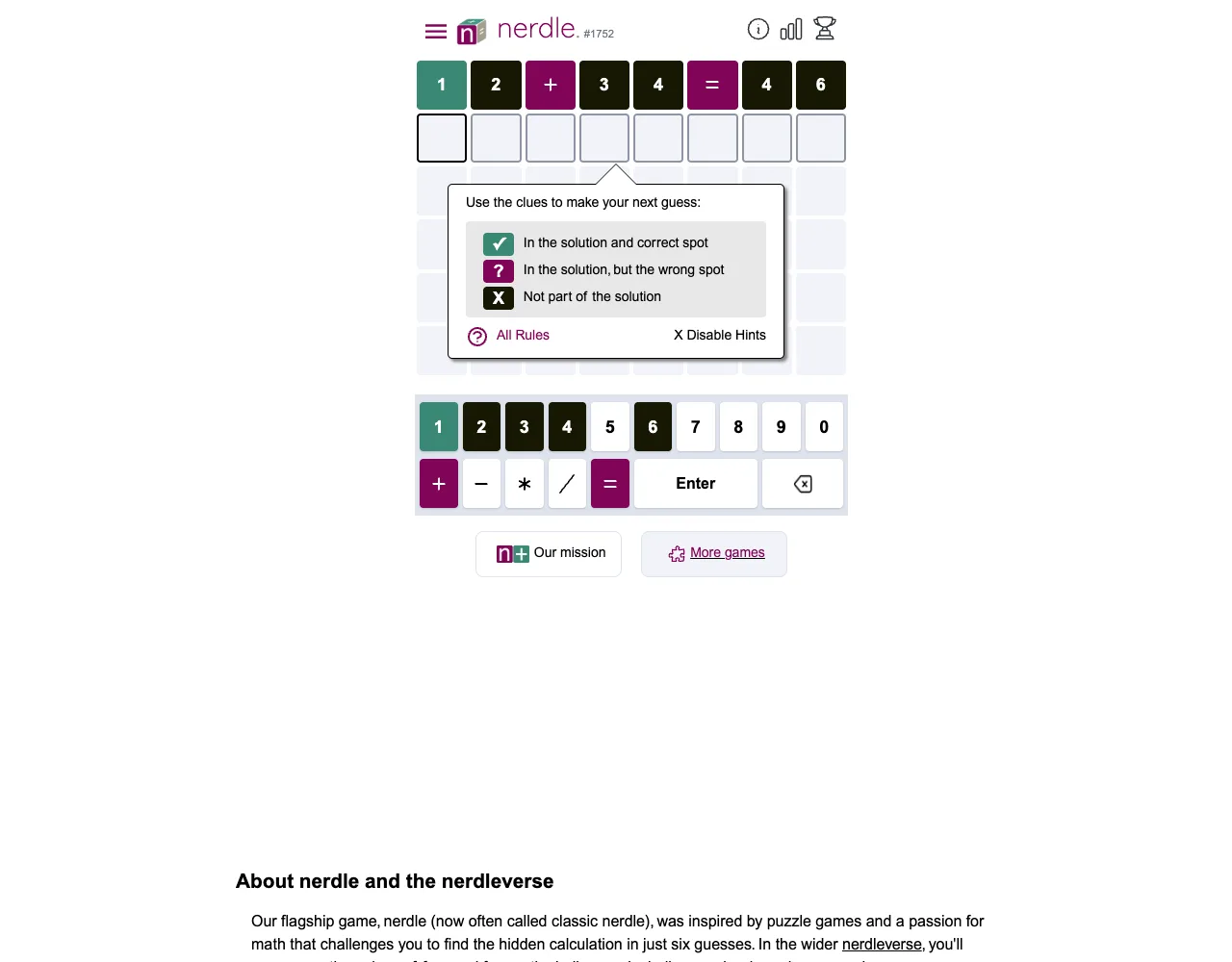
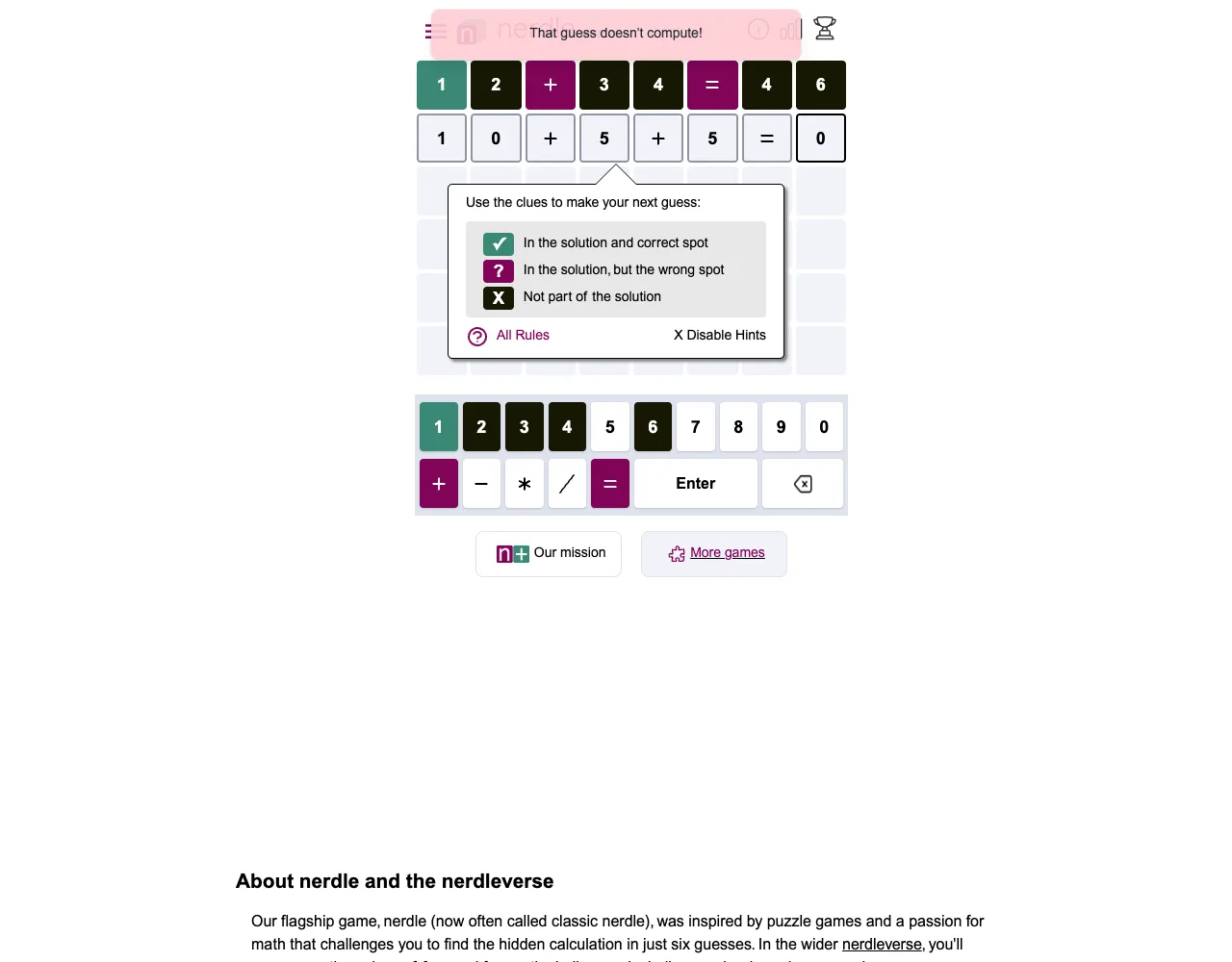
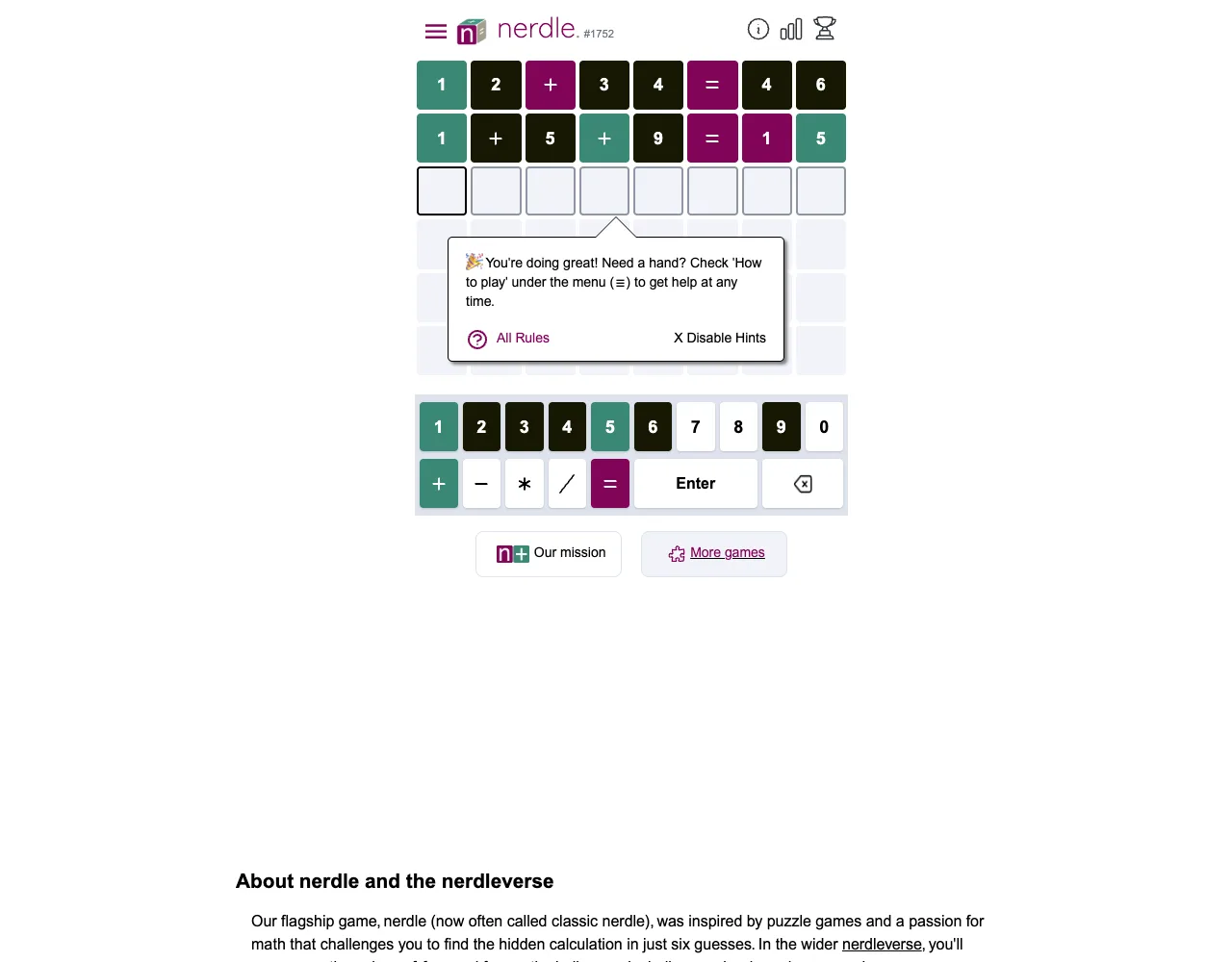
Our desktop test accepted 12+34=46 as a guess. An intermediate entry, 10+5+5=0, produced “That guess doesn't compute!” and did not consume another row. We corrected the entry and submitted 1+5+9=15, which received normal color feedback. Neither accepted equation solved the puzzle.
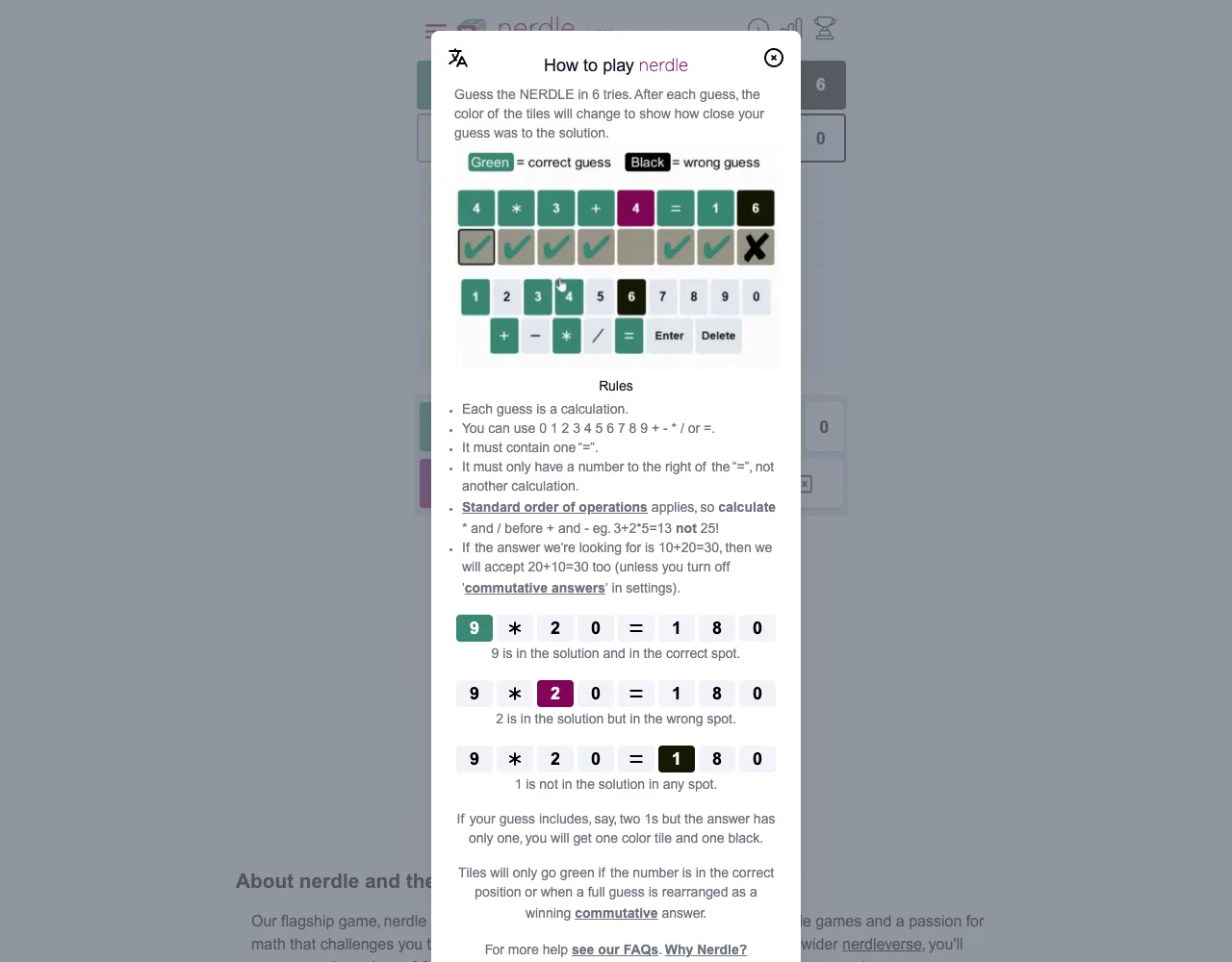
Every tile counts, including operators and the equals sign. The in-game rules require a number on the right of the equals sign, rather than another calculation. They also use normal arithmetic precedence: multiplication and division are evaluated before addition and subtraction. Count the characters and check the arithmetic separately before trying to interpret a rejection as feedback about the answer.
A black duplicate does not erase a colored copy
Green marks the correct character in the correct position. Purple means the character appears elsewhere in the answer. Black can indicate an absent character, but repeated characters need more care: an extra copy can be black even when another copy of that character is green or purple.
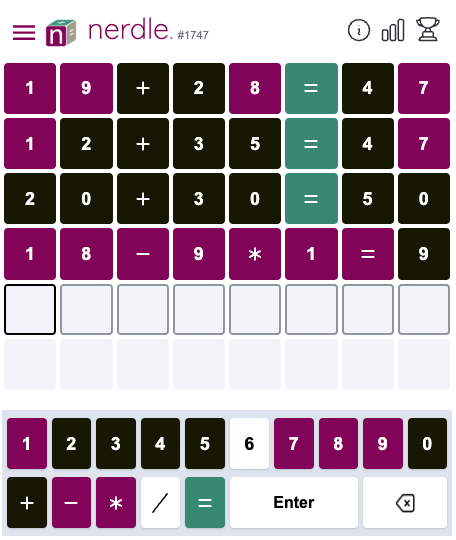
We saw this in the second accepted guess, where repeated plus signs and repeated 5s received different colors. The useful conclusion is about how many copies the feedback allows. It would be a mistake to discard every 5 merely because one copy was black. Compare the copies within the same row before updating your next calculation.
The official Nerdle help covers these rules and the setting for commutative answers. Check that setting when a reordered but equivalent calculation appears relevant; equivalence and tile position are distinct parts of the game.
Build a calculation that tests what is left
After a scored guess, keep the fixed green positions in view and move purple characters into plausible new positions. Any exploration still has to fit into a true 8-character calculation. An opener with many different characters can gather information, while a repeated character can test multiplicity. The next equation must account for both placement and the number of copies still possible.
This check covered the classic desktop board and help after the unaided inputs. Other variants, leagues, saved statistics and mobile controls were not tested. If an entry is rejected, first fix its arithmetic; if it is accepted but wrong, use the colors to change the next calculation.
FAQ about Nerdle
Does a calculation that does not compute use a guess?
The false equation in our test was rejected with an error and did not consume a scored row. A corrected valid equation could then be submitted.
Can the same digit be both colored and black?
Yes. When you enter more copies than the answer contains, an extra copy can be black while another is green or purple. Read all copies together.
Does Nerdle calculate strictly from left to right?
No. The rules use normal precedence, with multiplication and division evaluated before addition and subtraction. The expression must be mathematically valid.
Player reviews
0 reviewsPlayed it? Share what you think and help the next player choose.
Your experience
Games like Nerdle
All math games →
Mathler
MathIn Normal mode, find a hidden six-character calculation that equals a displayed target, using feedback on digits and operators.

Primel
MathFind a five-digit prime in six guesses, using digit positions and a prime-only entry rule.

sedecordle
WordSolve sixteen five-letter words with a shared stream of guesses and a 21-guess limit in the original Sedecordle mode.

Chessle
Board & CardReconstruct a hidden chess opening for both sides, using six submissions and colored move feedback in Normal or Expert mode.

Word Waffle
WordSwap the supplied letters into crossing words, using position colors and a limited move counter.

Dordle
WordSolve two five-letter words with seven shared guesses, using separate board feedback and a keyboard split between the two answers.