
1 / 3
VideoSemantle asks you to find a hidden word through semantic similarity. Each guess receives a numerical score, while sufficiently close guesses also receive a proximity rank. There is no row of colored letters to tell you which positions to keep.
Similarity and proximity measure different things
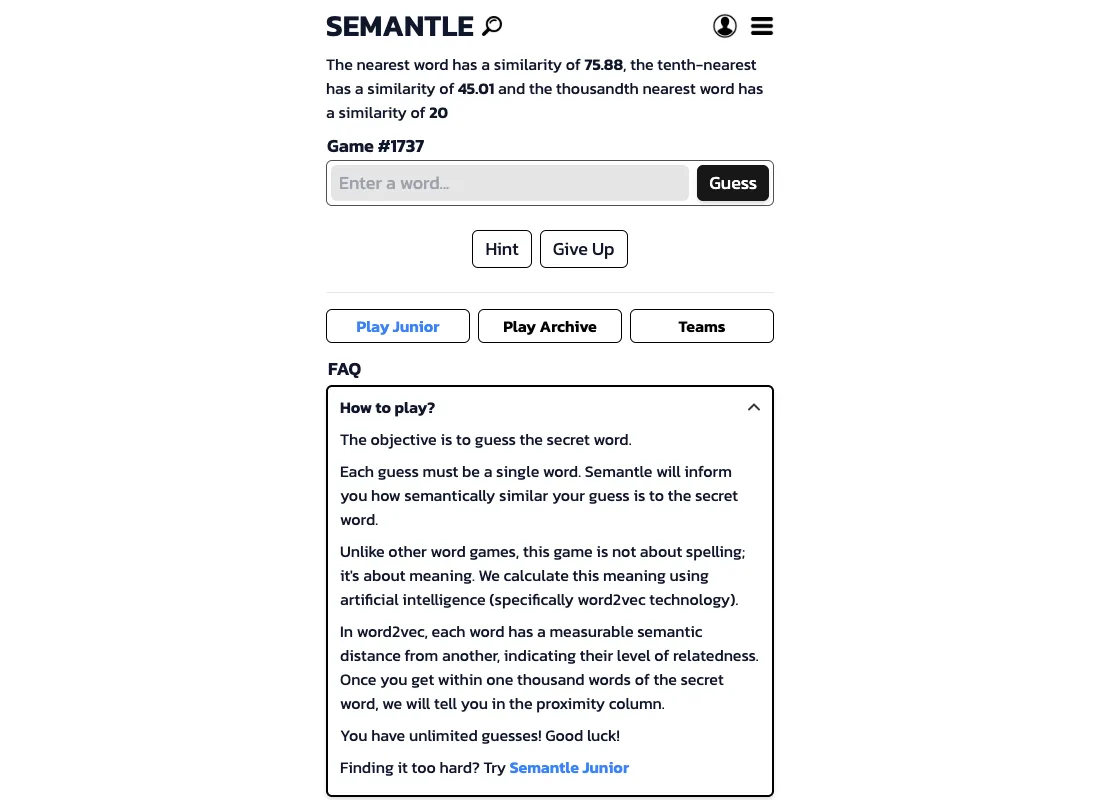
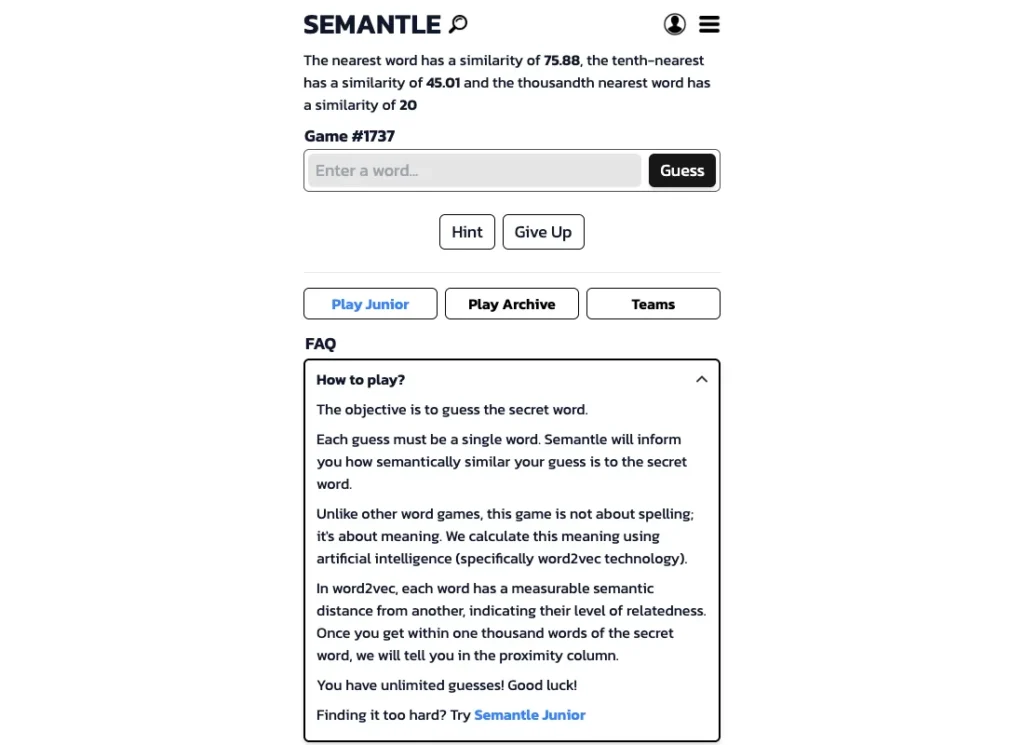
The official FAQ explains that Semantle uses word2vec representations. Words can be associated through the contexts in which they occur, so a useful guess need not be a dictionary synonym. You have unlimited guesses to explore those connections.
Similarity is the model's score for your guess against the target. Proximity places a qualifying guess among the 1,000 nearest words, with a higher proximity number indicating a closer word. A guess outside that group can still have a numerical similarity score while its proximity reads “cold.” The similarity threshold for entering the group changes with the day's target.
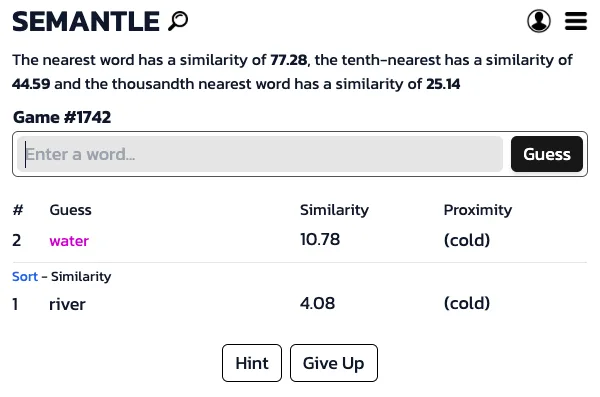
Our two guesses in game #1742 show that distinction. RIVER scored 4.08 and WATER scored 10.78, but both were cold. WATER improved the similarity without reaching the nearest thousand. The page supplied reference similarities of 77.28 for the nearest word, 44.59 for the tenth, and 25.14 for the thousandth. Those were reference points for that puzzle, not scores every daily game must use.
Players have raised the same similarity-versus-proximity question. The distinction is useful because a rising similarity score alone does not mean that a numbered proximity result should already appear.
Build on evidence without expecting a straight climb
Start by testing different ideas, then compare related words around a better result. If several guesses in one direction remain cold, another context may be more informative than another spelling variation. The model's associations can take an indirect route, and one improved guess does not prove that you have found the answer's category.
The results table keeps the guess number, word, similarity, and proximity together. Hint and Give Up are separate controls below it. We left both untouched and stopped after the two accepted guesses, with the puzzle unsolved. That session verifies the input and feedback loop; it does not establish a usual solve time or an optimal opening.
Use the day’s reference scores to read a cold result. In our session, 10.78 was an improvement over 4.08, but both were still below the displayed 25.14 threshold for the thousandth-nearest word.
FAQ about Semantle
Why is my guess still cold when its similarity improves?
Cold means the guess is outside the 1,000 nearest words. Similarity can improve without reaching that group; the current puzzle shows reference similarities above the input.
Should proximity go up or down?
A higher numbered proximity is closer to the answer. Similarity is a separate model score; proximity gives a rank only for guesses inside the nearest 1,000 words.
Are guesses limited?
No. Semantle allows unlimited guesses. Hint and Give Up are optional controls, which we did not use in the recorded session.
Player reviews
0 reviewsPlayed it? Share what you think and help the next player choose.
Your experience
Games like Semantle
All word games →
Conexo
WordGroup 16 words into four connections. The fourth selection submits automatically; correct groups reveal their category and leave fewer tiles to sort.

pedantle
TriviaUncover the title of a hidden Wikipedia page by revealing words in its introduction, with lexical clues for nearby guesses.

Redactle
TriviaUncover words across a redacted encyclopedia article and use their distribution to deduce its hidden title.

Letter Tax
WordAnswer seven categories while permanently taxing letters out of later words, then weigh rescue help against leaderboard eligibility.

Decoys
WordChange one letter in every word to uncover a shared secret group. Decoys separates harmless typos from real-word slips and marks solves that use its single reveal.

sedecordle
WordSolve sixteen five-letter words with a shared stream of guesses and a 21-guess limit in the original Sedecordle mode.