
1 / 2
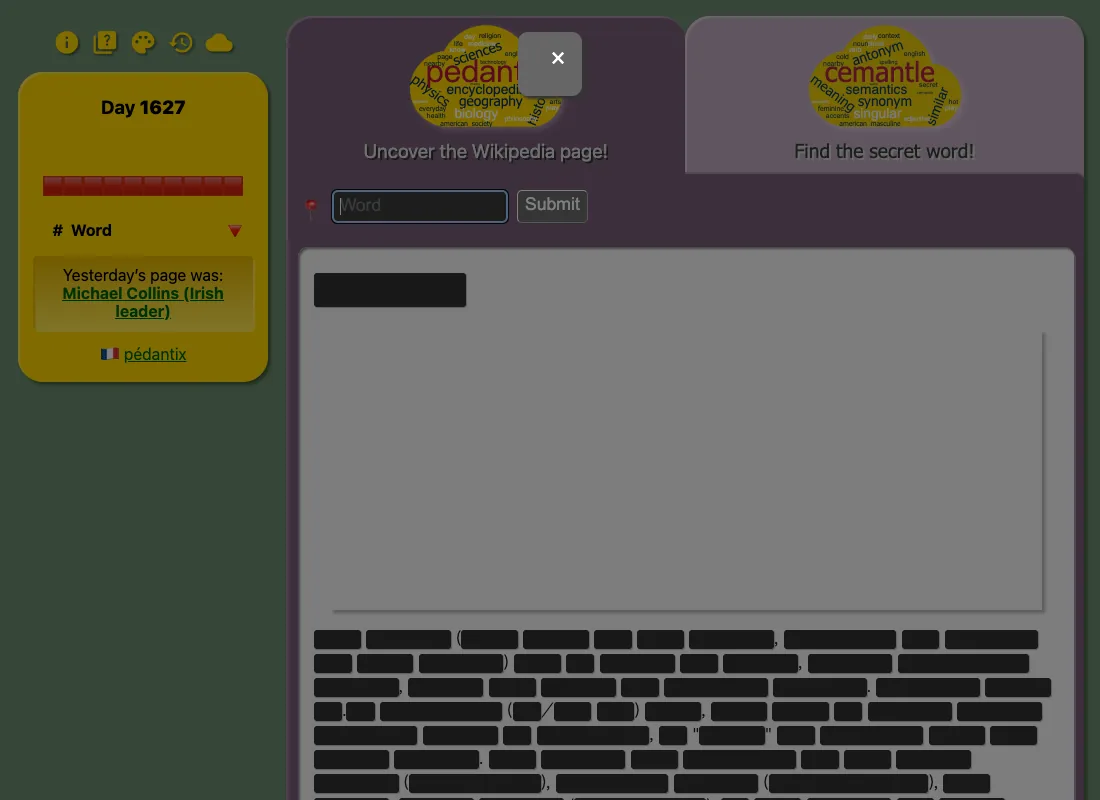
Pedantle hides a Wikipedia page behind black boxes. You identify the page by guessing words from its introduction and gradually exposing the text. The article gives you context to investigate; the hidden title remains the objective.
Reveal the introduction a word at a time
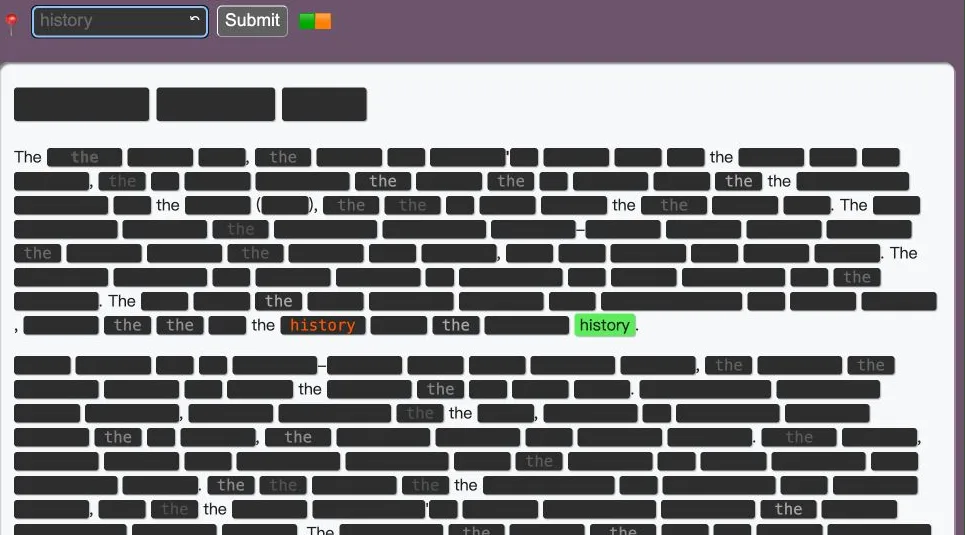
Type a word and submit it. In our desktop session, “the” uncovered many exact matches across the introduction. A second guess, “history,” revealed exact occurrences and an orange nearby form. The page retained both guesses in its history, so we could inspect the growing text without losing track of what had already been tried. We stopped with the title concealed.
The official help distinguishes exact matches from lexical neighbors. Correct words appear clearly, while related words can appear in shades of gray. A partial-looking reveal therefore need not mean that you typed the article’s exact word. Look at the surrounding sentence and the strength of the reveal before deciding what the passage says.
Pedantle also accepts roots that reveal plural or conjugated forms, according to its help, and guesses are case-insensitive. You do not need to spend separate attempts on capitalization. We verified the ordinary submission loop, but did not test every inflection or spelling variant.
The title follows a stricter rule
Unlike the introduction, the title does not give gray proximity clues. Its words are either revealed or hidden. A guess that seems thematically close may help uncover the article without exposing any part of its title.
Black boxes can be clicked to check word length. That provides another constraint when the sentence structure suggests several possible words. Combine the visible text with those lengths rather than treating a broad topic guess as a confirmed identification.
There is no six-guess grid to exhaust. The help describes solving over many guesses, and its ranking position is separate from the number of guesses used. Our two submissions were exploratory; they do not establish a typical solve length or a fastest opening. Choose an unrevealed word that would clarify the article’s subject or connect two exposed passages.
FAQ about pedantle
Why can a guess reveal a related word instead of an exact match?
The introduction offers lexical proximity clues as well as exact matches. The official help describes shaded related words; treat them as clues, not confirmation of exact wording.
Does the title also show near matches?
No. The help says title words are either revealed or hidden, without the gray proximity clues used in the introduction.
Do capitalization and word endings require separate guesses?
Guesses are case-insensitive. The help also says a root can reveal plurals or conjugated forms; we did not test every possible inflection.
Player reviews
1 review- Fun
- 5.0 / 5
- Creativity
- 5.0 / 5
- Ease of play
- 5.0 / 5
 Dlerank teamTeam
- Fun5/5
- Creativity5/5
- Ease of play5/5
pedantle looked like five minutes. The coffee went cold.
Your experience
Games like pedantle
All trivia games →
Redactle
TriviaUncover words across a redacted encyclopedia article and use their distribution to deduce its hidden title.

Semantle
WordCompare word-vector similarity and top-1,000 proximity in a daily semantic guessing game with unlimited attempts.

Wikitrivia
HistoryInsert historical event cards into a growing timeline, with three mistakes available and links to the underlying Wikidata and Wikipedia records.

Conexo
WordGroup 16 words into four connections. The fourth selection submits automatically; correct groups reveal their category and leave fewer tiles to sort.

Contexto
WordFollow contextual word rankings toward the secret word at number 1, with unlimited guesses and a list that keeps your closest attempts in view.

Connections
WordSort sixteen words into four precise groups while managing four mistakes, ambiguous meanings and competing category ideas.