
1 / 3
VideoOn this page
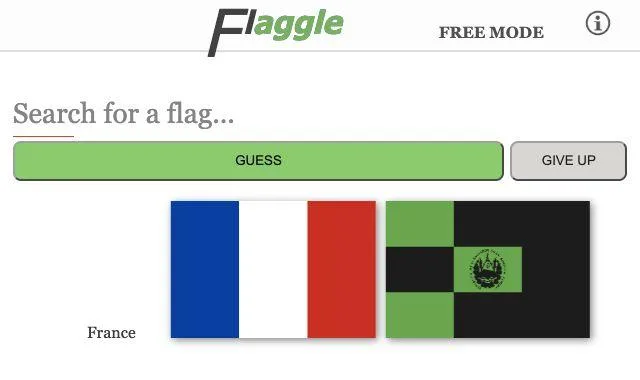
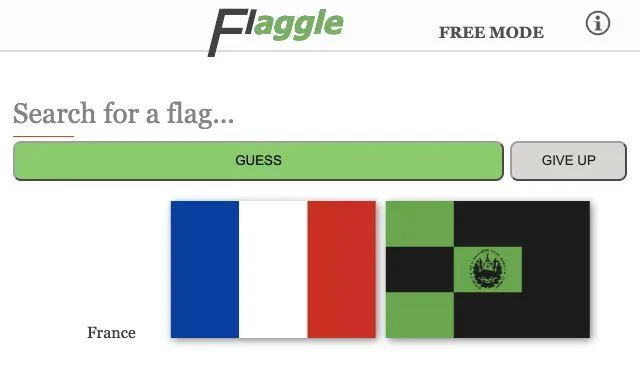
Flaggle hides a country or territory's flag and gives you a colour-position comparison after each guess. You choose a flag by name, then compare its familiar design with a second image: green marks places where your guess and the hidden flag have the same colour. The challenge is reading those patches as evidence about a layout you cannot yet see.
Read the mask beside the flag
The original guessed flag stays visible beside its similarity image. That pairing matters because green is the feedback colour, not necessarily a colour in the answer. A green patch over a yellow stripe means yellow matched there; a green patch over white means white matched there. The official rules reduce the flag palette to ten common colours, so the comparison uses a simplified version of each design.
Our daily run finished in three guesses without a hint or an answer lookup. One opening produced no green regions. The next guess exposed a much smaller matching shape than its own large areas of colour suggested. Comparing those shapes led to the winning country.
Change the layout you are testing
A blank similarity mask still tells you something: none of that guessed flag's displayed colour positions matched. It does not establish that every colour in the guess is absent from the answer. After an unhelpful opening, a differently arranged flag can test other parts of the image.
The history lets you compare successive guesses instead of remembering each mask. In our run, the broad colour blocks of one flag and the smaller central shapes of another provided different clues. Looking at the original beside each mask was more useful than treating the green area as a partial picture of the hidden flag.
Daily mode and another flag to practise
After completing the daily puzzle, we followed the Free Play link into a separate round. The same search box, Guess button and side-by-side feedback appeared under a Free Mode label. That round ended in two guesses, confirming that the daily result was not the end of available play.
The result panel counted guesses and offered a copy-result control. We verified the displayed score but did not publish a shared result. A Give Up button was also present during play; our two rounds were solved without using it, so its exact behaviour is not assessed here.
Flaggle suits players who enjoy turning flag knowledge into a visual test. Keep track of which original colour sits beneath each green patch, then choose the next flag to probe a different arrangement.
FAQ about Flaggle
Does green mean the hidden flag is green?
No. Green marks a matching position in the comparison image. Read the original guessed flag beside it to see which colour matched there.
Can I play another round after the daily flag?
Yes. The daily result offers Free Play. We followed that link and completed a separate Free Mode round using the same search and comparison controls.
Player reviews
0 reviewsPlayed it? Share what you think and help the next player choose.
Your experience
Games like Flaggle
All geography games →
GeoQuest
GeographyLocate the requested countries on a world map in a daily quest or regional practice. Retry mistakes, zoom into small countries and compare first-try accuracy when the round ends.

Flagle.io
GeographyReveal a daily flag tile by tile and combine its colours with distance, direction and proximity clues within six guesses.

Flagle
GeographyIdentify a flag through matching pixels, overlap percentages and six country guesses in the flagle-game.com version.

Worldle
GeographyRead a country or territory outline, then combine distance, direction and proximity across six geographical guesses.
pinfact
GeographyPin locations that fit five daily facts in pinfact, balancing map accuracy with bonuses for less common answers.
Far-Fetched
GeographyJudge seven unusual headlines as real or fake in Far-Fetched, then pin where the true stories happened.