
1 / 2
On this page
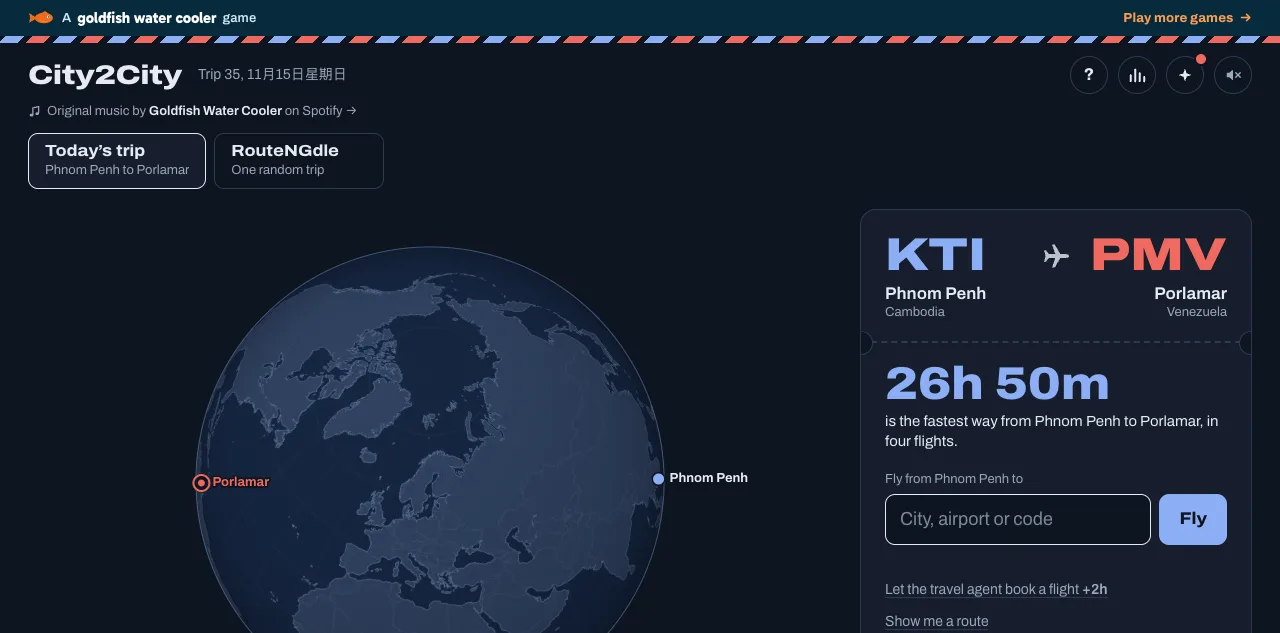
City2City gives you a departure, a destination and a fastest possible journey time. Your job is to connect them using real nonstop passenger routes. A geographically sensible stop can still be a poor choice: the result adds scheduled flight durations and 1 hour 15 minutes at every connection, so a small detour or an extra change can erase the benefit of a shorter flight.
Read the ticket after every landing
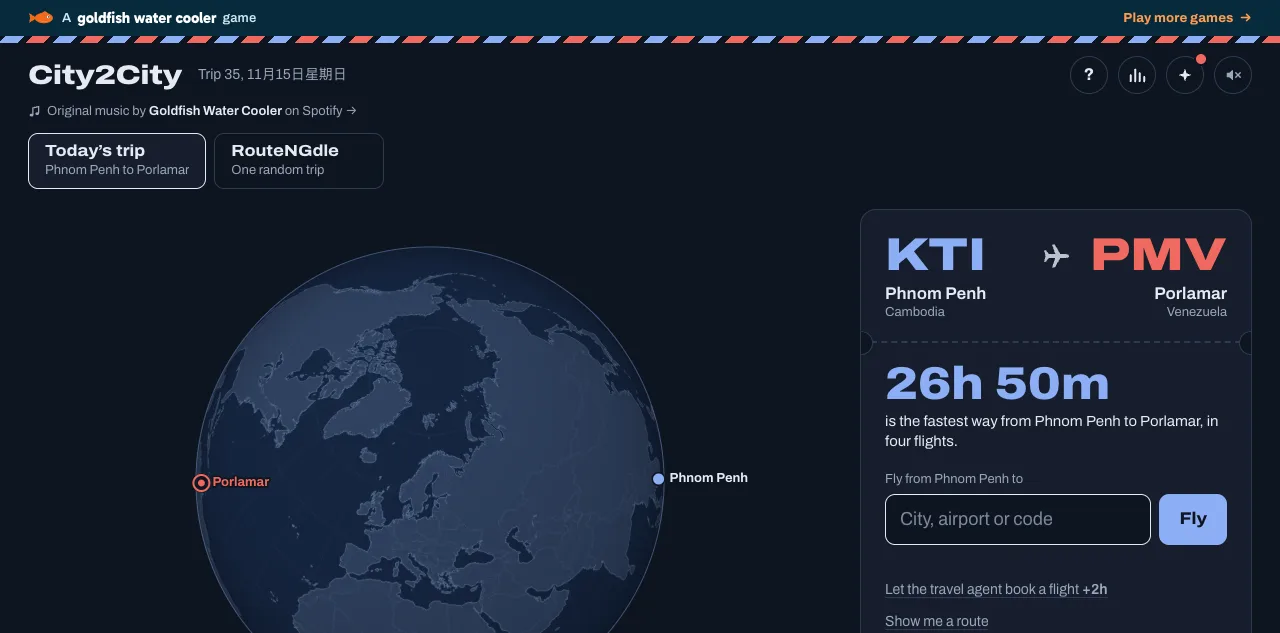
Type a city, an airport name or an airport code, choose the matching place and press Fly. Airports serving the same city count as one location. The globe traces the journey while the ticket reports the fastest remaining time and the number of flights that would take from your new position.
Those updates make a wrong turn useful without resetting the trip. In our completed daily test, one successful connection was marked as being on the fastest route; a later flight was accepted but left us 1 hour 35 minutes behind the best route. Both landed normally. Choosing a city without a nonstop service produced a different response: we stayed put and lost an additional hour at the rebooking desk.
The final ticket recorded four flights and a total of 29 hours 25 minutes, including that penalty. That is simulated travel time. Spending longer thinking about the next airport did not itself add hours to the itinerary.
Assistance has a price
The travel agent costs two hours and chooses a flight that gets you closer. The official help says it avoids the fastest option unless there is no alternative, so it trades a better position for a worse time. We completed the daily trip without using it. The separate Show me a route control offers a way out when you want the solution rather than another guess.
A useful approach is to treat each landing as a fresh route problem. Compare the remaining benchmark with the leg you just took, then consider a hub with service toward the destination. Repeatedly trying distant cities at random is costly because even a rejected booking adds time.
Different days, different route lengths
According to the help, the optimal daily journey takes three flights Monday through Thursday, four on Friday and Sunday, and five on Saturday. Hard mode hides the globe until arrival. A practice trip and the separate RouteNGdle tab are also available; our completed test covered the standard daily trip.
The route information is a scheduled-flight snapshot, with its fetch date shown in the help. Routes come from flightsfrom.com through the credited airline-route-data project. Use the game’s accepted connections as puzzle rules rather than as confirmation that a flight can currently be booked.
FAQ about City2City
What happens if there is no nonstop flight?
You stay in your current city and add one hour to the trip as a rebooking penalty.
Can I enter an airport code instead of a city?
Yes. City names, airport names and codes such as LHR are accepted. Airports in the same city count as one place.
Does the travel agent choose the fastest route?
Usually no. It costs two hours and books a flight that gets you closer, avoiding the fastest option unless there is no other choice.
Is this based on live flight availability?
The help describes scheduled passenger routes from a dated dataset. It is a route puzzle, rather than a live availability or booking search.
Player reviews
0 reviewsPlayed it? Share what you think and help the next player choose.
Your experience
Games like City2City
All geography games →
GeoQuest
GeographyLocate the requested countries on a world map in a daily quest or regional practice. Retry mistakes, zoom into small countries and compare first-try accuracy when the round ends.

Flagle.io
GeographyReveal a daily flag tile by tile and combine its colours with distance, direction and proximity clues within six guesses.

Flagle
GeographyIdentify a flag through matching pixels, overlap percentages and six country guesses in the flagle-game.com version.

Worldle
GeographyRead a country or territory outline, then combine distance, direction and proximity across six geographical guesses.
pinfact
GeographyPin locations that fit five daily facts in pinfact, balancing map accuracy with bonuses for less common answers.

Far-Fetched
GeographyJudge seven unusual headlines as real or fake in Far-Fetched, then pin where the true stories happened.