
1 / 2
VideoOn this page
Blackout asks you to remove letters until the remaining grid reads correctly in two directions. Black out selected squares so that the remaining horizontal and vertical words have at least three letters, while matching the black-square counts along the edges. The letters you keep must also remain connected. It is a word puzzle with a counting problem wrapped around it: a promising word is only useful if the rest of the grid still works.
Read the counts without losing the words
Start with the numbered rows and columns. A green number means you have placed exactly that many black squares; red means you have placed too many. A dot is an unknown count, not a request for zero black squares. That distinction becomes useful on boards with incomplete edge information.
Matching a count does not prove that a row is correct. In our Easy attempt, an early choice satisfied a row count but left an invalid short fragment and pushed a column above its allowance. The red column number exposed the contradiction. Two presses of Undo restored the earlier position, letting us reconsider which adjacent squares to remove.
The official rules make an important distinction about single letters. A letter may stand alone horizontally if it belongs to a valid word vertically, or the other way around. A two-letter run is never allowed. You also cannot black out a dividing line that separates the kept letters into disconnected groups, even if each group contains plausible words.
Green is a note you make
A normal click cycles a square through unmarked, kept green, black and clear. Right-clicking marks it black directly, which worked in our desktop test. Green squares record your intention to keep letters; they are not a certificate that the whole arrangement is correct.
Ordinary play outlines invalid word runs in red. The optional Blind mode removes that help, and the rules say it must be enabled before the first move. Beginners have a good reason to leave it off while learning how the word and count constraints interact.
Undo is particularly useful when a locally attractive word creates trouble elsewhere. We verified that it removed our mistaken marks and restored the black-square total. Redo then became available, although we did not use it. The rules also list keyboard controls, including Space to black out a square and K to keep one; our solve used the mouse.
What a finished daily attempt looks like
After completing the small interactive practice on Type Ten’s official site, we played the November 14, 2026 Easy daily puzzle independently. It had six columns, seven rows and thirteen required black squares. The game recognized the completed arrangement automatically and reported 1:02, no hints and a Clean solve badge. We did not consult solution footage before that attempt.
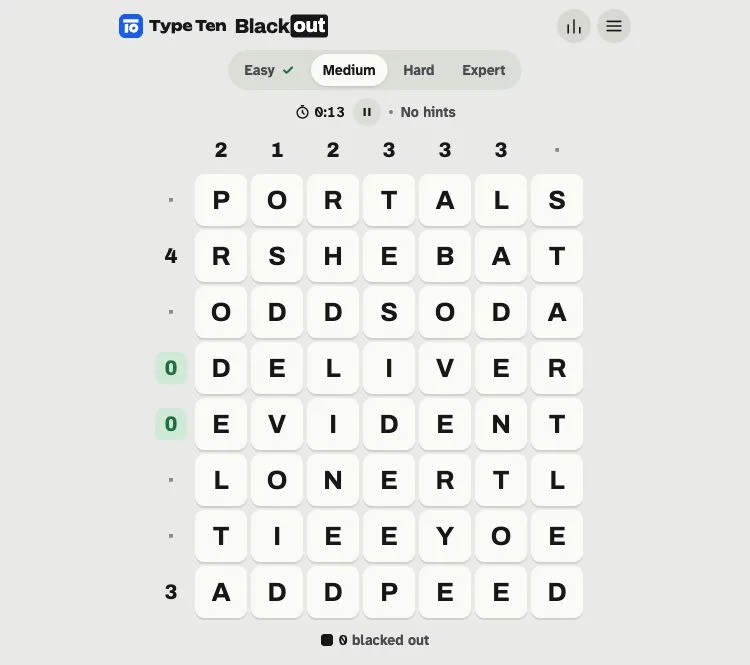
That was one completed Easy puzzle, not a test of every difficulty. The daily selector also offered Medium, Hard and Expert. We opened Medium to inspect its larger board and missing count clues, but left it unsolved. The screenshot shows that untouched Medium puzzle rather than revealing the completed Easy answer.
Choose how much help to use
The rules describe hints as permanent marks that can supply a black square, identify a kept letter or correct a mistake. The result records hint use beside the time. Give Up reveals the solution and counts the attempt as unsolved. We inspected these rules without using either option during our daily finish.
Type Ten provides the game in a browser without requiring an account for the daily play we tested. Ads were present below the board. An archive and Unlimited option were visible, but we did not test their access conditions. The official help says new daily puzzles arrive at midnight in your own time zone; a midnight rollover was outside our session. The strongest part of the observed loop was resolving a conflict between words and numbers, then seeing both sets of constraints agree at the finish.
FAQ about Blackout
What does a dot beside a Blackout row mean?
Its required black-square count is unknown. It does not mean zero; use the words and other clues to infer the arrangement.
Can a single letter remain in Blackout?
Yes, if it belongs to a valid word in the other direction. Runs of exactly two letters are not allowed.
Does marking a square green mean it is correct?
Green is your own keep mark. You still need valid words, the correct black-square counts and one connected group of kept letters.
How does Blind mode change Blackout?
It removes the red outlines that ordinarily identify invalid word runs. The official rules say to turn it on before making the first move.
Player reviews
0 reviewsPlayed it? Share what you think and help the next player choose.
Your experience
Games like Blackout
All logic games →
Platonix
LogicGuess a hidden word using totals for exact matches, misplaced letters and misses. Play a daily puzzle or choose a word length in Unlimited.

Boxed In
LogicFit nine supplied words into a shared letter grid, using the given letters and placement previews.

Symble
LogicSolve a five-letter word in eight guesses while deducing what three changing symbols mean and reading feedback in answer order.
Shiftogram
LogicInsert blue letters and shift the starting rows to solve a 4×4 crossword whose clues have no assigned positions.
Meshword
LogicSolve a word grid from scrambled letter groups along its rows and columns. Meshword combines word deduction with spacing rules, daily difficulty choices and a finite practice collection.
Daily Gogen
LogicArrange letters on a connected grid so every listed word can be traced through neighboring cells. Daily Gogen offers three grid sizes, with fixed letters guiding each solve.