
1 / 3
VideoOn this page
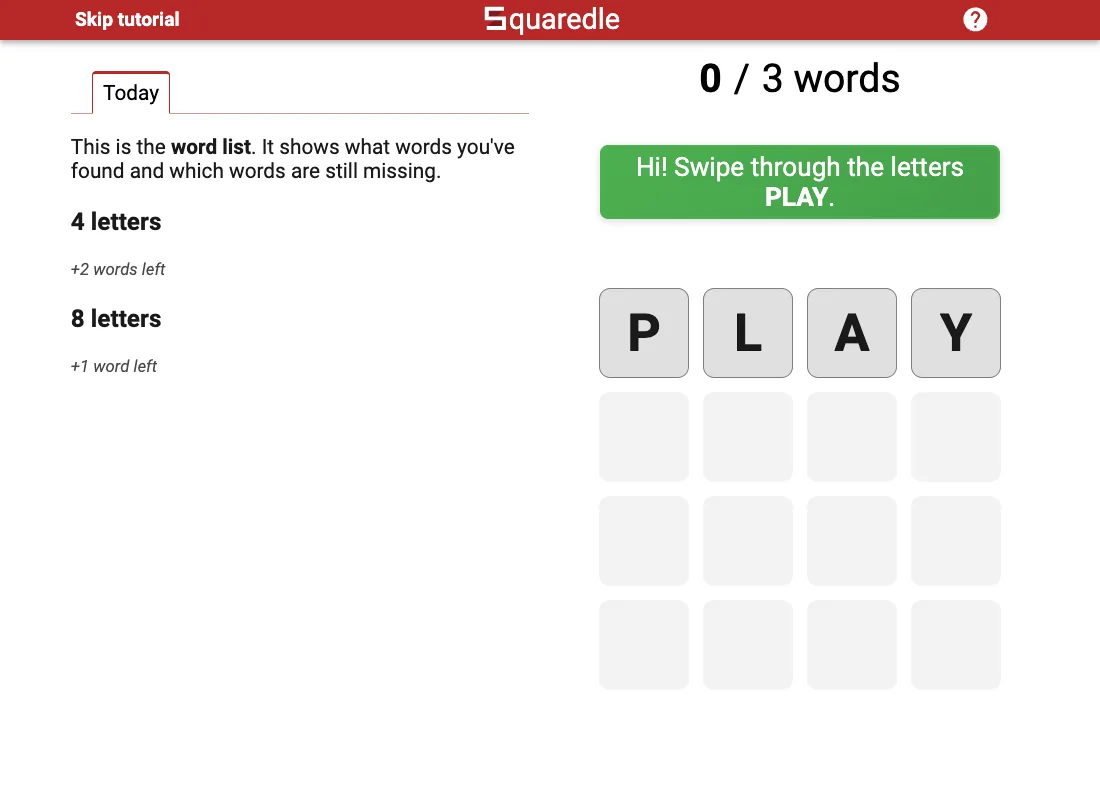
Squaredle turns a letter grid into a word list you uncover by tracing paths. Move through adjacent squares, including diagonals, to spell a word; a square cannot be reused within the same path. Accepted required words advance the completion counter, while bonus words are tracked separately.
A path can turn between letters
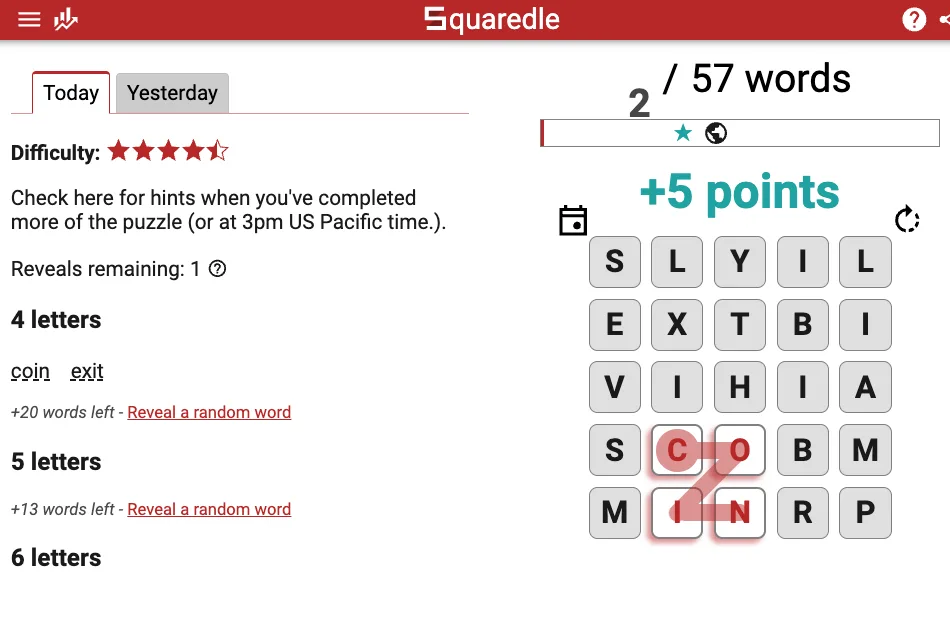
After skipping the guided tutorial, we played a 5×5 puzzle with 57 required words. EXIT was accepted first. COIN followed a route that moved right, diagonally down-left, then right again. Both words entered the four-letter list, bringing the required total to 2/57. Each acceptance displayed +5 points in this session.
The image shows COIN's actual path and the two recorded words. A route is a chain of neighboring squares, not a straight line that must continue in one direction. When scanning for another word, try turns around a promising letter pair rather than reading only rows and columns.
Required words and bonus words have different jobs
The official FAQ says the dictionary is based on the 2023 NASPA Word List, using lowercase words rather than proper nouns, abbreviations, or hyphenated forms. Accepted words are divided into required and bonus lists. Their classification considers frequency and editorial judgment; knowing a real word does not guarantee it belongs in the required set.
Players discussing favorite bonus words offer examples of words they look for, but those suggestions do not prove that a word can be traced in every puzzle. The grid still has to supply a legal path.
Our board had 69 possible bonus words, with none found during the two-word test. That separate total did not reduce the 57-word required target. We did not use the available Reveal control.
Use progress clues without treating them as exclusions
The FAQ explains that, as you progress, letters unused by remaining required words can fade. Such a square may still belong to a bonus word. It also documents keyboard entry and cycling through repeated-letter choices, which can help when several identical letters are available. Our recorded input used pointer paths, so those typing controls were researched rather than tested.
The word list grouped finds by length and left room for missing entries. You can use those length groups to choose where to resume searching. We stopped at two required words; this was a test of tracing and feedback, not a completed puzzle or a measurement of typical difficulty.
FAQ about Squaredle
Can I use diagonal squares?
Yes. Neighboring diagonal squares are allowed. Our accepted COIN path included a diagonal step, and you can turn while tracing a word.
Do bonus words count toward finishing the required list?
No. Bonus words are tracked separately. Our puzzle showed a 57-word required target and a separate 69-word bonus list.
Why does a familiar word count as bonus instead of required?
The FAQ says required-word selection considers frequency and editorial judgment. The underlying word list can accept a word without making it a required answer.
Can faded letters still be used?
Yes. The FAQ says letters unused by remaining required answers can fade as you progress, but they may still appear in bonus words.
Player reviews
0 reviewsPlayed it? Share what you think and help the next player choose.
Your experience
Games like Squaredle
All word games →
Letter Tax
WordAnswer seven categories while permanently taxing letters out of later words, then weigh rescue help against leaderboard eligibility.

Decoys
WordChange one letter in every word to uncover a shared secret group. Decoys separates harmless typos from real-word slips and marks solves that use its single reveal.

sedecordle
WordSolve sixteen five-letter words with a shared stream of guesses and a 21-guess limit in the original Sedecordle mode.

Transfiguword
WordSolve three definition clues, bank their letters, then rearrange the full pool into two new answers and a mystery word.

Wordgy
WordJoin a chain of compound words and two-word phrases, with free direction changes and optional score-reducing help.

Wordsummit
WordTrace adjacent letters to find the highest-scoring word on a 5×5 board. Five attempts, tile multipliers and coloured feedback make each path a deduction.