
1 / 2
VideoOn this page
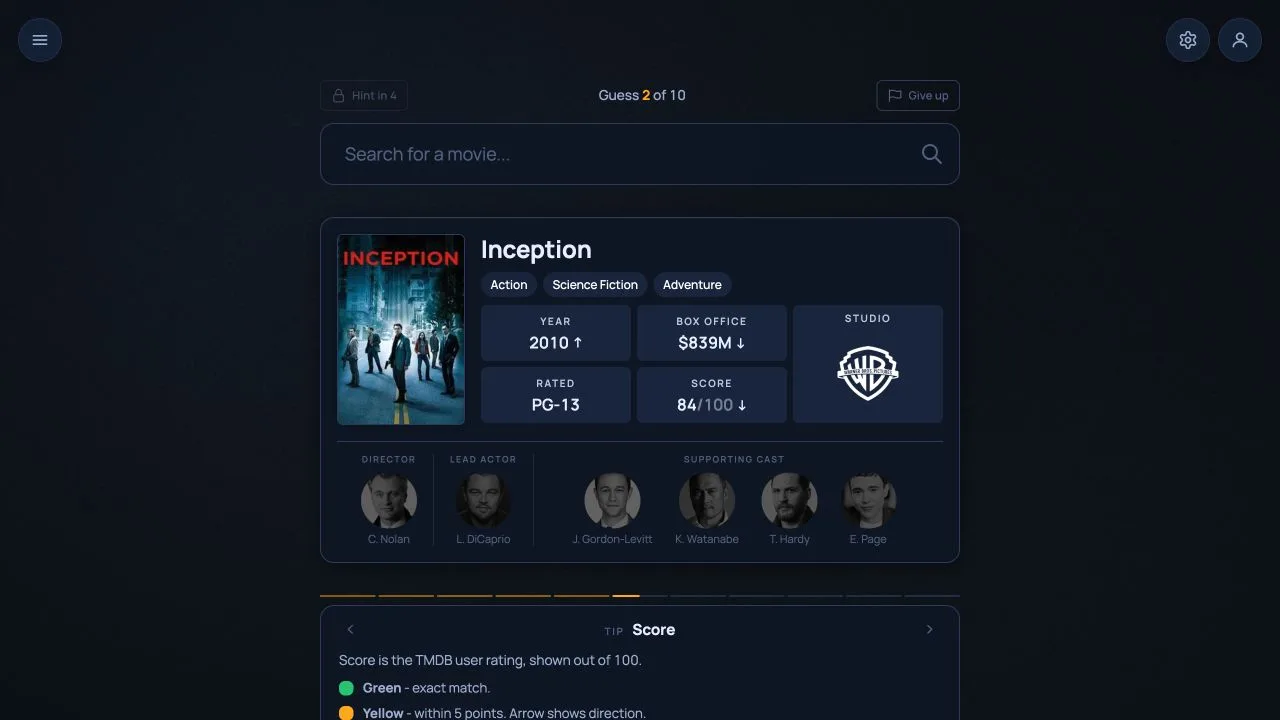
Spotle Movies asks you to identify one hidden film in ten guesses, but the useful part is what happens after a wrong title. Each submission becomes a dossier: release year, worldwide box office, score, rating, studio, director and cast, plus genre tags. A film you know well can be a useful probe even when it is unlikely to be the answer.
This is the movie edition at spotle.movie, rather than the music artist guessing game also called Spotle. There are no film stills to identify or audio clips to recognize. You work from metadata and the connections between films.
Read the card before choosing another title
Type a title into the search box and select its result from the dropdown. The card then compares that film with the target. Green marks an exact match; yellow indicates a close or related match; gray leaves that attribute unmatched. Arrows on numerical fields tell you whether to move higher or lower.
Our first wrong submission produced a year arrow pointing upward, while both its box office and score pointed downward. That is a more useful instruction than simply “try a different film”: look later in time, below that commercial scale, and below that score. Later submissions fixed the year while leaving other fields unresolved. Once a field turns green, keep that constraint in view rather than starting a fresh chain of unrelated guesses.
The official rules make the numerical tolerances explicit. A yellow year is within five years of the target, box office is within $100 million, and score is within five points. Score means the TMDB user rating displayed out of 100. Box office means worldwide theatrical receipts, rather than budget or domestic earnings. A non-theatrical release can show Streaming or TV instead of a dollar amount.
Those distinctions matter when narrowing a list. Two films with very different reputations can sit close together on the displayed score, while a low-budget film can still have a comparatively large worldwide gross. Use the values shown on the card rather than treating either field as a subjective quality judgment.
People and studios add a second route
The cast row separates the lead actor from supporting cast. A green person matches the same role category; yellow can mean that person appears in the target in a different category. A yellow actor is therefore still a connection worth following, even if the lead slot is wrong. Director feedback can also reflect a shared co-director.
Studio feedback is broader than a simple name comparison: the rules allow yellow for sister labels under a common parent. Treat a yellow studio as a family connection, not confirmation of the exact label. Genre tags offer another filter, with matching genres highlighted in green.
These fields reward a different choice from pure numerical narrowing. A film may be a useful next guess because it tests an actor or a director, even if its release year is already a poor fit. The cost is one of the ten available submissions, so decide which uncertainty the next title is meant to resolve.
Hints arrive after several wrong guesses
In our session, five incorrect submissions unlocked the first optional hint. Its menu offered Awards, Filmography and Studio. Choosing Filmography revealed another film by the target’s director; afterwards, the next hint remained locked until the eighth guess. This gives a stalled run a more specific lead without immediately naming the film.
We completed the tested daily round on guess six with official hint assistance. The run tested the search dropdown, repeated wrong guesses, numerical and identity feedback, hint unlocking and the completion screen; it was not an unaided solve. The result screen displayed the guess count, a share option and the next-film countdown. Current answers are omitted here so the mechanics remain useful on a different day.
The game’s help describes a library of more than 3,000 films, not an exhaustive film database. If a title is absent from autocomplete, that does not establish anything about the hidden answer. Use a listed film to test the connection you have in mind instead of repeatedly trying alternate spellings of an unsupported title.
FAQ about Spotle Movies
What rating does Spotle Movies use for its score?
It uses the TMDB user rating displayed out of 100. Yellow means the guessed film is within five points of the target.
Why is an actor yellow rather than green?
The person can appear in the hidden film in a different role category. A green actor matches the same lead or supporting category.
When can I use a hint?
The first hint unlocks after the fifth wrong guess and the second after the eighth. Hints are optional; our test used the Filmography option.
Why can’t I find a movie in the search dropdown?
The official help describes a selected library of more than 3,000 films rather than every release. A missing search result can mean that title is outside the library.
Player reviews
0 reviewsPlayed it? Share what you think and help the next player choose.
Your experience
Games like Spotle Movies
All movies & tv games →
Lost in Translation
Movies & TVIdentify a movie from its foreign release titles translated back into English. New translations and optional help compete for the same five-guess budget.

Cinematrix
Movies & TVFill a 3×3 film grid by satisfying both crossing clues, with nine total guesses and no repeated titles.

CineNerdle
Movies & TVSwap a 4×4 board of film clues into movie groups, using 15 swaps to uncover four films and a fifth intersecting connection.

Actorle
Movies & TVInfer an actor from masked film titles, release years, genres and IMDb ratings, then use age and shared-film feedback.

Flickle
Movies & TVIdentify a film from successive clips, with six attempts shared between guesses and skips.

Box Office Game
Movies & TVIdentify five films from a US box-office weekend, choosing which paid hints are worth their points.