
1 / 3
VideoSearchle turns a starting Google search prompt into a missing-word puzzle. You see the beginning of a query and a grid for one missing word. The prompt gives your vocabulary search a topic, while the tiles tell you whether a candidate's letters belong in the answer.
That creates two jobs at once: think of a completion people might search for, then test it against the word length and accumulated feedback. A phrase that sounds sensible can still be the wrong completion. Treat the topic as a clue rather than proof that your first association must be correct.
Read the grid before typing
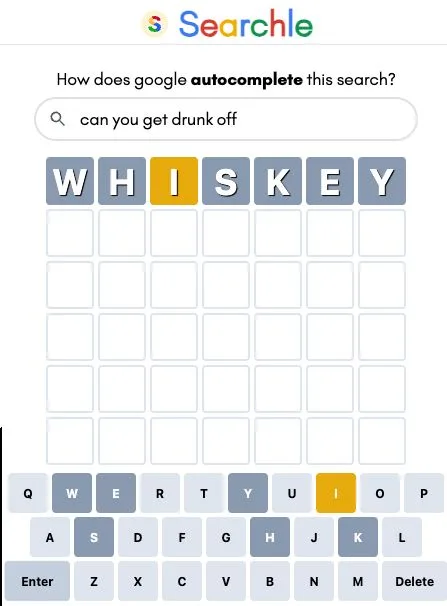
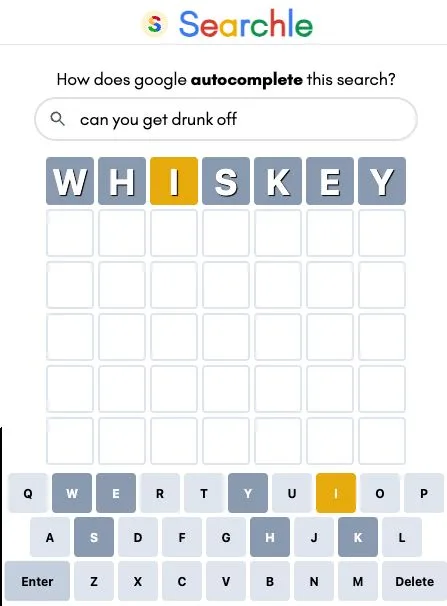
Our daily board had seven columns and six guess rows. We entered WHISKEY unaided for the displayed prompt. The game accepted the seven-letter word and returned gray tiles except for a yellow I. Its on-screen keyboard retained the same color information. We did not solve the daily answer.
An earlier incomplete entry produced “Not Enough Letters.” That message matters because the search field appearance can suggest a free-form query. The actual submission needs to fill the answer grid; entering a shorter related word does not advance the puzzle. Count the visible columns before committing.
The keyboard provides Delete and Enter as well as letter buttons. If a physical-key input has not registered as expected, inspect the row before submitting. The visible grid is the useful confirmation of what will actually be sent.
Let meaning and letters constrain each other
After a rejected completion, separate the letters that still have value from those the board has ruled out. In our test, the yellow tile supplied a reason to keep a letter in consideration while changing its position. Repeating the same arrangement would ignore the information just gained.
The next candidate also needs to make sense after the search prompt. A word chosen only to fit the letter pattern may be a poor completion; a compelling phrase that contradicts feedback is equally unhelpful. Alternate between those two checks instead of guessing a series of loosely related terms.
The official About page describes Searchle as a daily secret-word game built around starting Google search prompts and credits Ryan Carmody and Praveen Latchamsetty. That framing does not establish that the displayed completion is a live popularity ranking. We treat it as the game's puzzle clue and do not infer current search-volume data from it.
The interface includes archive and account links, but this test covered the current daily board. The screenshot shows one accepted guess and its feedback without revealing a completed solution.
FAQ about Searchle
Why does a related word produce Not Enough Letters?
The guess must fill the visible answer grid. Count its columns; a shorter completion is not a valid submission.
Is the clue a live search-popularity ranking?
The official About describes a daily puzzle based on a starting Google search prompt. It does not establish a live ranking or a current search-volume measurement.
Player reviews
0 reviewsPlayed it? Share what you think and help the next player choose.
Your experience
Games like Searchle
All word games →
Letter Tax
WordAnswer seven categories while permanently taxing letters out of later words, then weigh rescue help against leaderboard eligibility.

Decoys
WordChange one letter in every word to uncover a shared secret group. Decoys separates harmless typos from real-word slips and marks solves that use its single reveal.

sedecordle
WordSolve sixteen five-letter words with a shared stream of guesses and a 21-guess limit in the original Sedecordle mode.

Transfiguword
WordSolve three definition clues, bank their letters, then rearrange the full pool into two new answers and a mystery word.

Wordgy
WordJoin a chain of compound words and two-word phrases, with free direction changes and optional score-reducing help.

Wordsummit
WordTrace adjacent letters to find the highest-scoring word on a 5×5 board. Five attempts, tile multipliers and coloured feedback make each path a deduction.