
1 / 2
Mixed asks you to reverse a paint mixture. You see the finished colour, choose the paints that could have produced it in equal parts, then press Stir. There is no slider for changing the proportions: choosing a shade means adding one equal share of it.
The daily game has three rounds. You select two paints from six, then three from seven, then four from eight. The palette carries forward and gains a shade each round, so later mixtures give you more ingredients to separate by eye. Each paint can be selected once. When you reach the required number, the remaining choices become unavailable; Clear lets you reconsider before stirring.
Read the colour before picking the recipe
Start with how light or dark the target looks, then consider its hue. Freehand's help suggests Chalk as a clue to a pale mix and Ink as a clue to a deep one. These are starting points, not guarantees: every selected pigment changes the result, and a four-paint mixture can disguise its individual ingredients.
The developer describes a pigment model rather than an average of screen colours. Paint absorbs light, so its mixtures do not behave like adding coloured light on a display. That distinction matters when a combination looks plausible as a digital colour blend but wrong as paint.
Because every ingredient has the same weight, you cannot rescue an uncertain selection by using less of it. Before committing, ask what each chosen paint contributes to the target. A shade that pulls the mixture away from it is worth reconsidering even if the other choices seem convincing.
A close colour still earns credit
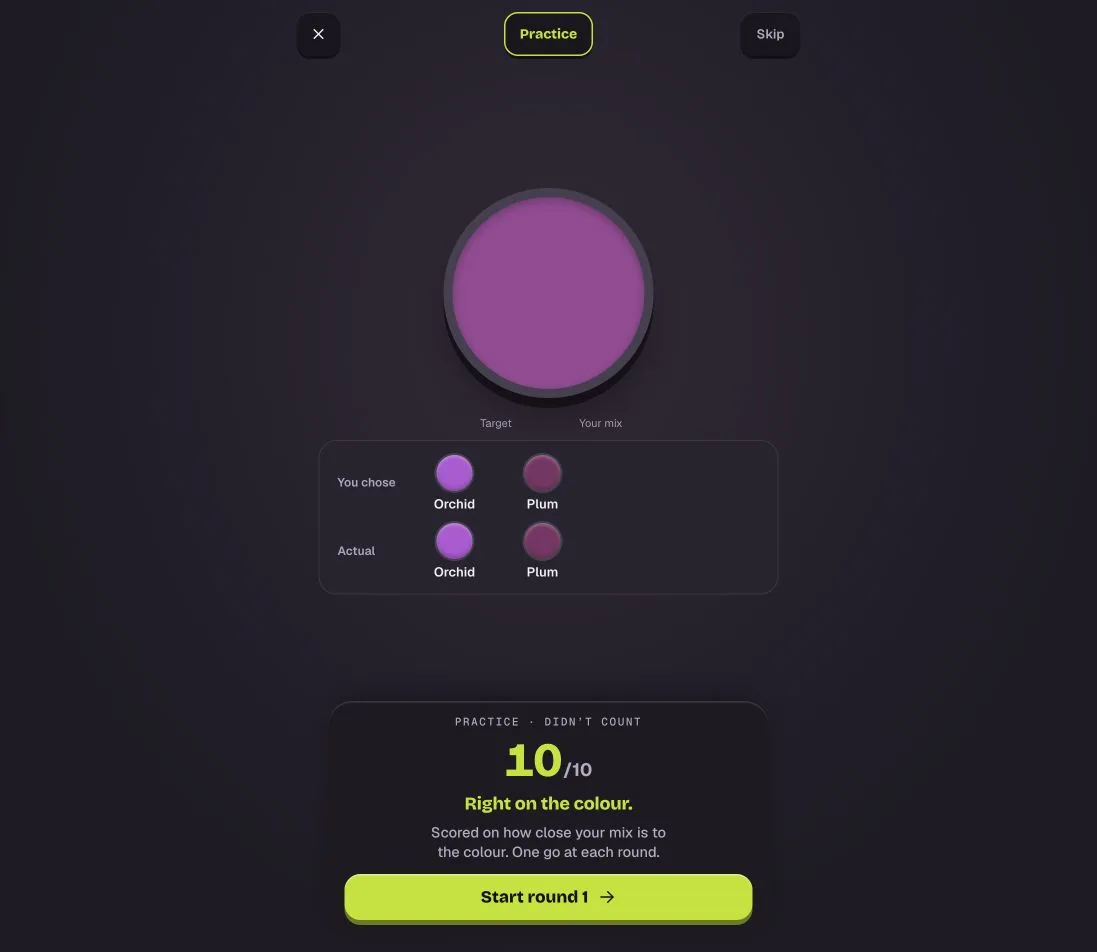
Mixed scores the resulting colour rather than simply counting correct ingredients. Each round is worth 10 points, for a daily maximum of 30. The reveal places your selected paints beside the actual recipe and compares the target with your mixture.
Our unaided daily test finished at 28/30. The first two mixtures matched; the four-paint round earned 8/10 despite one different ingredient. That result illustrates the useful distinction between finding the exact recipe and making a colour close enough to receive partial credit. It does not establish a general scoring formula.
The introductory practice does not count toward the daily score. Its result is the screenshot shown here, so it demonstrates the recipe comparison without revealing the current daily mixtures. Use that first stir to learn the feedback before spending the single submission available in each daily round.
FAQ about Mixed
Can I choose different amounts of the paints?
No. Each selected paint contributes one equal part, and each paint can be chosen only once. The three daily rounds require exactly two, three and four paints.
Is the score based on finding the exact recipe?
It measures how close the resulting colour looks to the target. A different recipe can receive partial credit; the help defines ten as a match the eye cannot distinguish.
Why does blue and yellow make green?
The game models how pigments absorb light. It is simulating paint mixing, rather than averaging the RGB values of screen colours.
Player reviews
0 reviewsPlayed it? Share what you think and help the next player choose.
Your experience
Games like Mixed
All color games →
Colorfle
ColorIdentify the colors behind a target mixture, using six rows of palette choices, position feedback and a similarity percentage.
Huedle
ColorRebuild a daily color gradient by swapping tiles between fixed corners, then check your speed and move efficiency.

Hexcodle
ColorMatch a target color by guessing its six-digit hexadecimal code, using directional and distance clues over five attempts.