
1 / 2
VideoOn this page
Middle Word asks where a secret word sits in the dictionary. Two visible words bracket it alphabetically, and every guess tells you how many dictionary entries separate that guess from the answer. You are narrowing a range of words rather than assembling letters from colored tiles.
The starting boundaries are 10,000 words before and 10,000 words after the target. That makes the first decision fairly broad: choose a word between them, then use the returned distance to decide which part of the interval deserves your next guess. The official help describes the answer as a common word in its basic form.
A number measures dictionary distance
After a guess, the game labels the word as alphabetically before or after the answer and gives its distance. The appropriate boundary changes, leaving a smaller interval around the hidden word. The visible color bars accompany that bracket; the explicit before/after labels and numbers are the clearest information to read.
A distance of 1,991 means there are that many dictionary words between the displayed word and the target. It does not mean the guess is close in meaning, and it says nothing about shared letters. Two similar-looking words can still leave room for many entries if they sit in a crowded part of the dictionary.
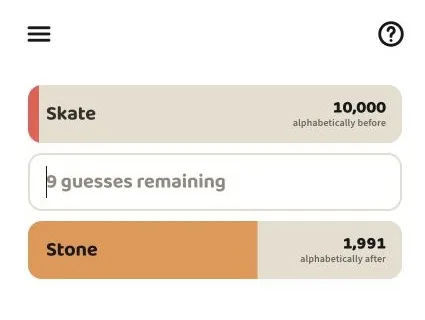
Our archive screenshot shows this distinction. One submitted word moved the upper boundary much closer while the lower boundary remained at its original distance. The input then reported nine guesses remaining. That counter makes a speculative word a real use of the available attempts, even if it leaves a helpful new boundary.
Let the bracket guide the next guess
In our completed daily, the initial words lay on opposite sides of the target. The first guess landed 1,864 entries before it; our second guess solved the puzzle. This was a single short session, with the official help consulted and no answer lookup or gameplay video used beforehand. It does not establish that other daily puzzles take two guesses.
A useful approach is to compare the start of the two boundary words before thinking about individual letters. If they already share a prefix, a guess from a distant part of the alphabet contributes little. When the interval is wider, choose a word that tests a meaningfully different section of the remaining range.
Exact numerical halves are difficult to predict without knowing the game’s dictionary. Use the distances to judge the effect of a guess rather than assuming that a word halfway between two spellings must divide the remaining entries equally. The feedback can reveal that one small alphabetical interval contains far more words than expected.
Earlier puzzles and answer selection
The completion screen credited the handcrafted puzzle to Daniel. The inspected pages did not establish a fuller creator name.
The menu also opened the previous day’s puzzle. We entered a fresh guess there to record an unsolved example with its own bracket and attempt counter. That archive position is used for the public image, keeping the completed current answer out of the screenshot.
FAQ about Middle Word
What do the numbers in Middle Word mean?
They count dictionary words between a displayed boundary and the hidden word. They do not measure spelling similarity or the number of shared letters.
Must Middle Word answers have five letters?
No five-letter restriction is stated in its help. It describes the target as a common word in its basic form; use the alphabetical bracket and distance feedback.
Can I revisit earlier Middle Word puzzles?
The menu opened the previous day’s puzzle during our test. It had its own starting boundaries and remaining-guess counter.
Player reviews
0 reviewsPlayed it? Share what you think and help the next player choose.
Your experience
Games like Middle Word
All word games →
Letter Tax
WordAnswer seven categories while permanently taxing letters out of later words, then weigh rescue help against leaderboard eligibility.

Decoys
WordChange one letter in every word to uncover a shared secret group. Decoys separates harmless typos from real-word slips and marks solves that use its single reveal.

sedecordle
WordSolve sixteen five-letter words with a shared stream of guesses and a 21-guess limit in the original Sedecordle mode.

Transfiguword
WordSolve three definition clues, bank their letters, then rearrange the full pool into two new answers and a mystery word.

Wordgy
WordJoin a chain of compound words and two-word phrases, with free direction changes and optional score-reducing help.

Wordsummit
WordTrace adjacent letters to find the highest-scoring word on a 5×5 board. Five attempts, tile multipliers and coloured feedback make each path a deduction.