
1 / 4
On this page
Loopism asks you to place loops where three constraints meet: the quota inside each region, the number beside each row and column, and a ban on loops touching—even at a corner. A cell can satisfy its own region and still be ruled out by a loop across the border. An exclusion in one region can narrow the choices in its neighbors.
Reading the board before placing a loop
Thick borders divide the board into regions. The usual quota is 1 loop per region, but some puzzles require 2 and announce that change on the board. Row and column numbers give exact totals: a 0 rules out the whole line, while a 2 requires two separated loops somewhere along it. The official rules also describe boards with gaps, where dotted guides help connect a clue to the cells on its line. A gap is not a playable square.
In our desktop test of Gentle 1, the board began with a supplied loop and automatic exclusion marks. We used the remaining region spaces alongside the row and column totals to place the other loops. The game updated its exclusions after each placement and recognized the finished board automatically. The result was “All on your own!” with “No help”; we used neither Check nor a hint. This was one completed Daily puzzle, not a test of all four difficulty groups.
Two kinds of X, and what a click changes
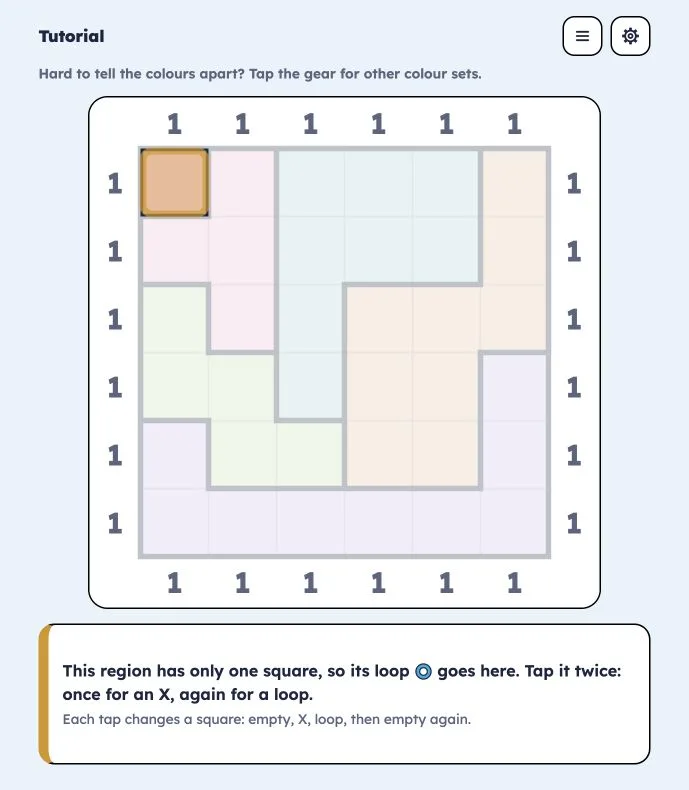
Clicking a cell cycles through empty, X, loop, then empty again. An X records that a loop does not belong there. From an empty cell, two clicks place a loop; one leaves an exclusion mark.
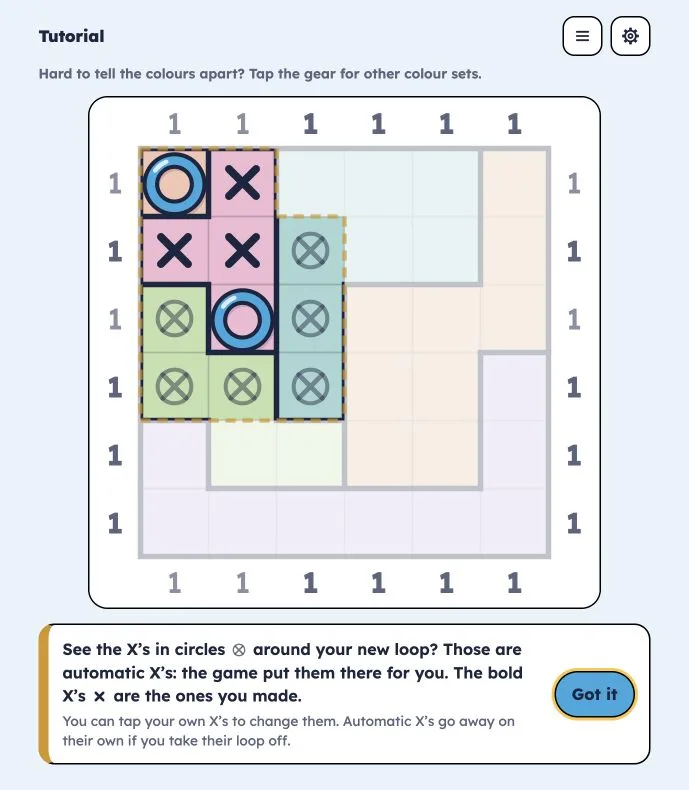
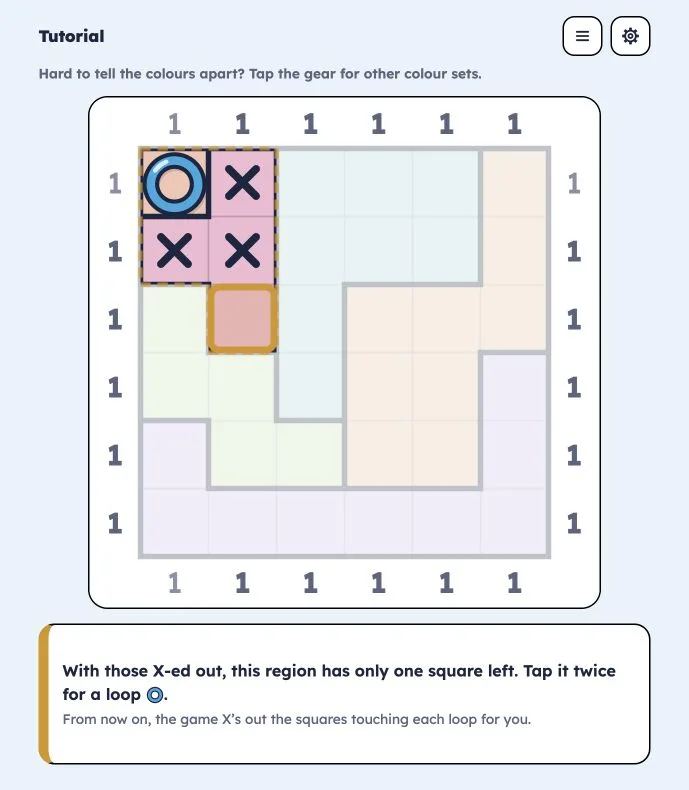
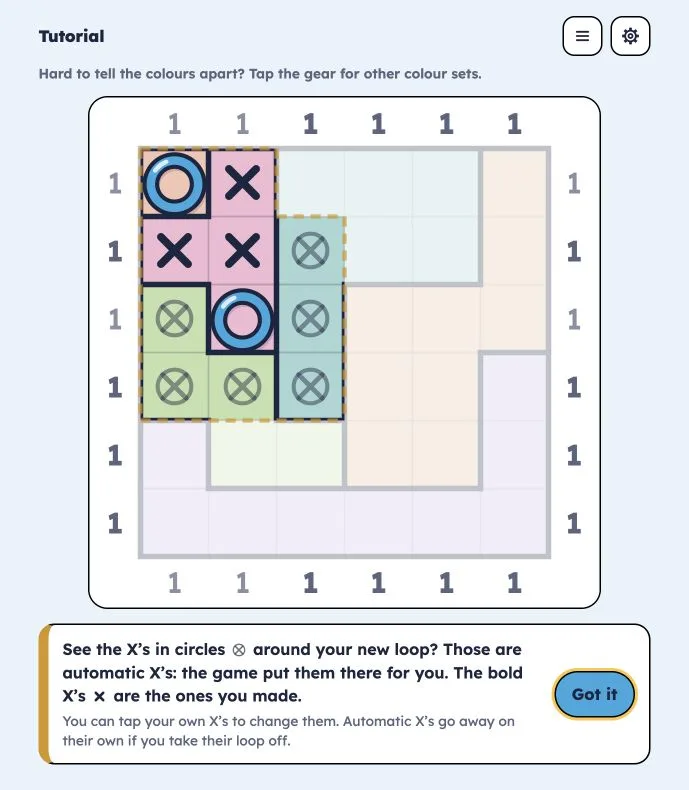
The tutorial makes the distinction visible. First it highlights a region with only one cell. After placing its loop, you mark the neighboring cells that cannot contain another one. Later, the board shows bold manual X marks alongside circled automatic X marks. The latter are generated by the game as placements rule out cells; their automatic behavior can be switched on or off under the gear menu.
Help changes the completion label
There is no clock to beat. Loopism instead distinguishes how much help went into a finish. Undo is free. X hint and Loop hint supply a next step, while Check assesses the current marks; each counts as 1 help. In the tutorial, pressing Check produced “Everything so far is right!” and explicitly explained that a real puzzle would charge 1 help for that check.
A gold “All on your own!” result requires no help. Blue “With a little help” allows some, with larger boards allowing more; gray “Team effort” covers more help or giving up. We verified the gold result on Gentle 1 and the tutorial's Check feedback, but did not measure the thresholds for the other labels.
Twenty Daily boards, with room to return
The Daily is split into Gentle, Sneaky, Tricky and Brutal, with 5 puzzles in each part. The homepage showed 1/20 completed after our win. Official help says the Daily puzzles are shared by everyone, and you can skip a board and return with its marks intact. You can work through whichever parts you want rather than treating all 20 as one required sitting. The homepage describes the reset as midnight “Lake Ontario time.”
FAQ about Loopism
Why do some X marks have circles around them?
Circled X marks are automatic exclusions generated by the game. Bold X marks are ones you entered yourself. Automatic marks can be switched on or off under the gear menu.
Does checking a correct board still count as help?
Yes. Each Check counts as 1 help in a real puzzle, even when the feedback says your marks are right. Undo is free, but X hint and Loop hint also cost 1 help each.
Can a region require more than one loop?
Yes. Some boards require 2 loops per region and announce that rule. The loops must still stay apart, including diagonally, and satisfy the exact row and column totals.
Do I have to finish all 20 Daily puzzles in order?
No. Official help says you can play as far as you like in any of the four parts, skip a puzzle and return to its saved marks. Each part contains 5 puzzles.
Player reviews
0 reviewsPlayed it? Share what you think and help the next player choose.
Your experience
Games like Loopism
All logic games →
Ponder Club
LogicA daily puzzle collection spanning words, numbers and visual games; tested here through Color Flood.

Ronin
LogicFill a 6×6 chess grid with one of each piece per region, keeping matching pieces out of attack. Use pencil notes and explore numbered past puzzles.

Nonograms
LogicFill black runs from row and column clues on 5x5 to 25x25 grids, request another standard puzzle, or choose scheduled special puzzles.
Guess a hidden word using totals for exact matches, misplaced letters and misses. Play a daily puzzle or choose a word length in Unlimited.

Boxed In
LogicFit nine supplied words into a shared letter grid, using the given letters and placement previews.

Unlabeled
LogicRestore eight missing axis labels across four charts, using numerical scales to separate the right labels from two decoys. Correct placements lock after each check.