
1 / 2
Every label in Hearsay changes how you should read a statement. Honest people tell the truth, while liars make false statements. Your job is to assign those roles across a grid so that the statements and the puzzle's additional rule agree.
Read the neighborhood carefully
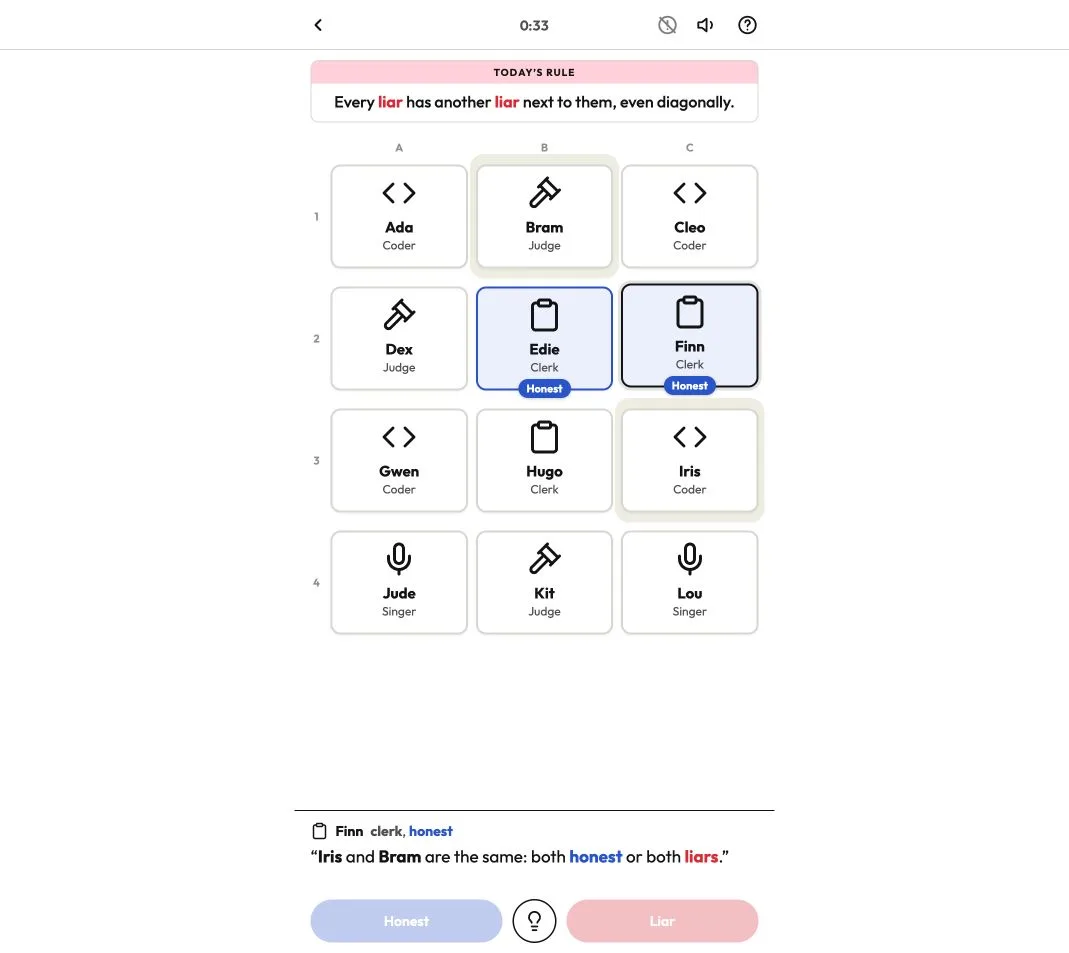
The tested daily had 12 characters arranged in four rows of three. Neighbor relationships included diagonals. A statement about adjacent people therefore needed the surrounding diagonal cells checked as well as the cells directly above, below or beside the speaker.
One honest character was provided as a starting point. Her truthful statement allowed our first deduction about another person. The important distinction is between knowing a speaker's role and knowing whether a particular claim is true: each confirmed role turns that person's statement into a constraint on the rest of the grid.
Daily No. 29 also required every liar to have another liar as a neighbor. That was a rule of the tested puzzle, so it should be read from the current board rather than assumed to apply to every future daily. An isolated liar would violate that condition even if some other statements appeared consistent.
Check the whole set of claims
A plausible assignment can still fail elsewhere. Before committing a new label, check the statements that mention that character and the daily rule. For statements involving counts, write down exactly which neighboring cells are included; forgetting a diagonal changes the count.
Our first deduction was unaided. We then used an offline constraint enumeration based only on the statements visible on the board, and entered the resulting roles through the normal interface. The completed board displayed “Case closed,” a time of 0:46 and no mistakes. This was an assisted completion; the displayed time is not an estimate of how long a new player should expect to solve the puzzle.
The interface also offered the past seven days and a random past puzzle. Those entries were observed, but their full access conditions were not tested.
FAQ about Hearsay
Do diagonal characters count as neighbors?
Yes. The tutorial includes diagonal characters in the neighborhood.
Is every liar required to have a liar next to them?
That was the extra rule for the tested daily, No. 29. Check the rule shown on the current puzzle before applying it.
Player reviews
0 reviewsPlayed it? Share what you think and help the next player choose.
Your experience
Games like Hearsay
All logic games →
Ponder Club
LogicA daily puzzle collection spanning words, numbers and visual games; tested here through Color Flood.

Ronin
LogicFill a 6×6 chess grid with one of each piece per region, keeping matching pieces out of attack. Use pencil notes and explore numbered past puzzles.

Nonograms
LogicFill black runs from row and column clues on 5x5 to 25x25 grids, request another standard puzzle, or choose scheduled special puzzles.

Guess a hidden word using totals for exact matches, misplaced letters and misses. Play a daily puzzle or choose a word length in Unlimited.

Boxed In
LogicFit nine supplied words into a shared letter grid, using the given letters and placement previews.

Unlabeled
LogicRestore eight missing axis labels across four charts, using numerical scales to separate the right labels from two decoys. Correct placements lock after each check.