
1 / 5
Videos · 2On this page
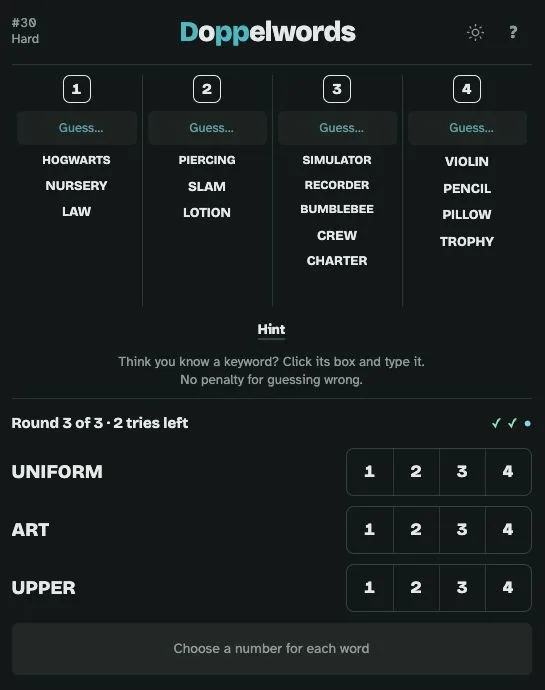
Doppelwords asks you to sort new words into four columns whose keywords are hidden. The words already in each column are your clues: work out what connects them, then choose a column number for each incoming word. Three rounds make this a compact daily word puzzle, but a plausible connection is not always the intended placement.
Read the columns before assigning words
Each round introduces three words. Use the numbered buttons beside each word to choose its column, then check the set. Looking at a single familiar pairing can be misleading: the official help warns that some words fit more than one keyword. Compare a candidate with several words already in a column before committing.
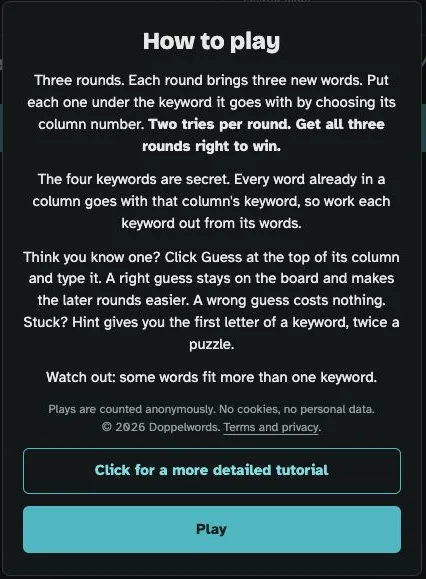
You do not have to name the four keywords to finish. There is a separate Guess box at the top of each column for players who want to test a connection explicitly. According to the help, a correct keyword stays visible and an incorrect keyword guess costs nothing. That makes the boxes useful for separating uncertainty about the connection from uncertainty about where a new word belongs.
Feedback narrows the next attempt
The daily puzzle we played was marked Hard and allowed two tries per round. In the first round, our initial assignment placed two words correctly and one incorrectly. The correct rows locked in, while the unsuccessful choice was disabled for the remaining word. We could correct that last placement without rebuilding the whole set.
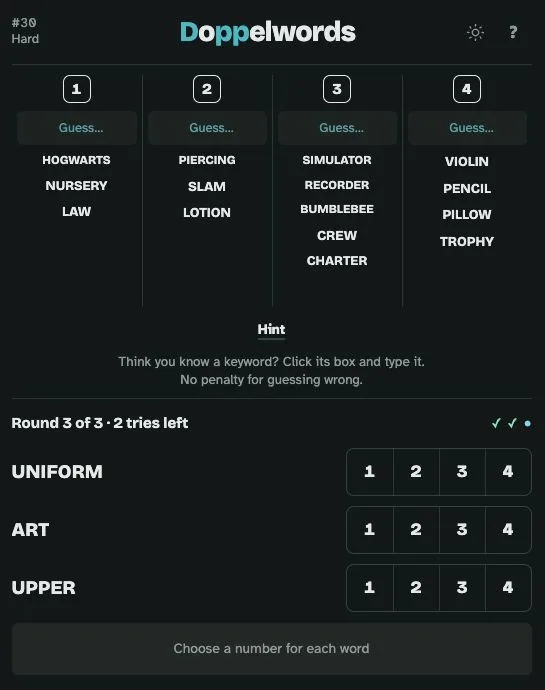
The interface also prevented two incoming words from using the same selected column. Treat the three placements as a set: a number that looks promising for one word may need to be reserved for another. After correcting the first round, we completed the next two and reached a solved screen with one wrong attempt recorded.
Difficulty matters when comparing results. Our tested Hard board showed two tries per round; the Medium board in Rangsk's gameplay footage showed three. Check the allowance displayed on your own board rather than assuming every puzzle has the same budget.
Hints and the final reveal
The help offers a first-letter hint for a keyword, twice per puzzle. We finished without using either hint or the keyword boxes, so those assistance rules come from the official instructions rather than a tested hint sequence.
At the end, the game revealed the keywords and explained their connections to the column words. That explanation is useful when a grouping felt less natural than an alternative you considered. The result also included a Share control and a message promising a new puzzle every day.
Doppelwords suits players who enjoy finding a common word behind several phrases, with the extra pressure of fitting new words into a growing board. The small number of placements keeps each round readable; ambiguous associations provide the resistance. A complete daily game was playable in our browser without registration. We have not established archive access, an unlimited mode, or the reset time.
FAQ about Doppelwords
Do I have to guess the hidden keywords to win?
No. You can finish by placing the incoming words in the correct columns. Keyword boxes are optional; the help says a wrong keyword guess has no penalty.
Do correct placements stay after a wrong check?
Yes. In our Hard game, two correct placements locked in while the remaining word could be reassigned. The failed column choice was disabled for that word.
How many attempts does Doppelwords allow?
Our Hard daily puzzle allowed two tries per round across three rounds. The Medium board in verified gameplay showed three tries per round, so use the allowance displayed on your board.
What does the Hint control reveal?
The official help says it reveals the first letter of a keyword and can be used twice per puzzle. We did not use hints in our completed game.
Player reviews
0 reviewsPlayed it? Share what you think and help the next player choose.
Your experience
Games like Doppelwords
All word games →
Letter Tax
WordAnswer seven categories while permanently taxing letters out of later words, then weigh rescue help against leaderboard eligibility.

Decoys
WordChange one letter in every word to uncover a shared secret group. Decoys separates harmless typos from real-word slips and marks solves that use its single reveal.

sedecordle
WordSolve sixteen five-letter words with a shared stream of guesses and a 21-guess limit in the original Sedecordle mode.

Transfiguword
WordSolve three definition clues, bank their letters, then rearrange the full pool into two new answers and a mystery word.

Wordgy
WordJoin a chain of compound words and two-word phrases, with free direction changes and optional score-reducing help.

Wordsummit
WordTrace adjacent letters to find the highest-scoring word on a 5×5 board. Five attempts, tile multipliers and coloured feedback make each path a deduction.