
1 / 3
On this page
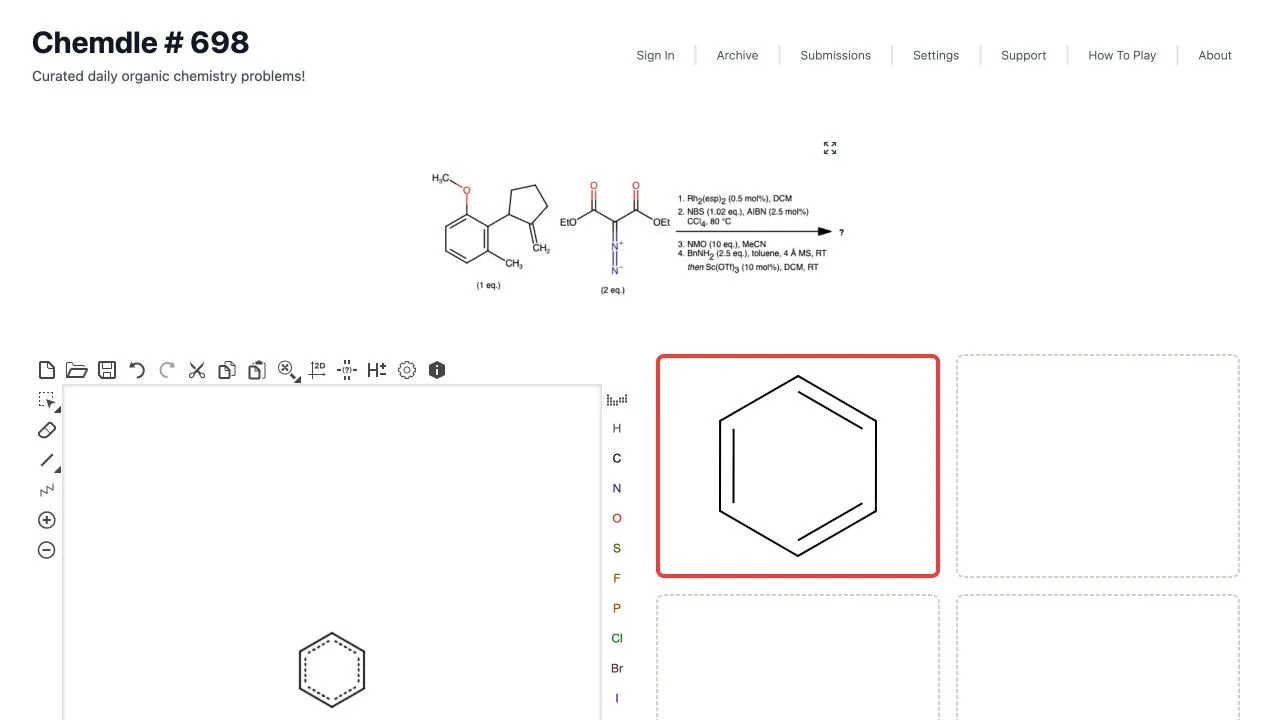
Chemdle presents an organic reaction scheme and asks you to supply a product structure. The question is drawn above a molecular editor, with the submitted attempts displayed alongside it. This is a chemistry problem answered by a structure, rather than a word guessed from a name.
Submit one connected compound
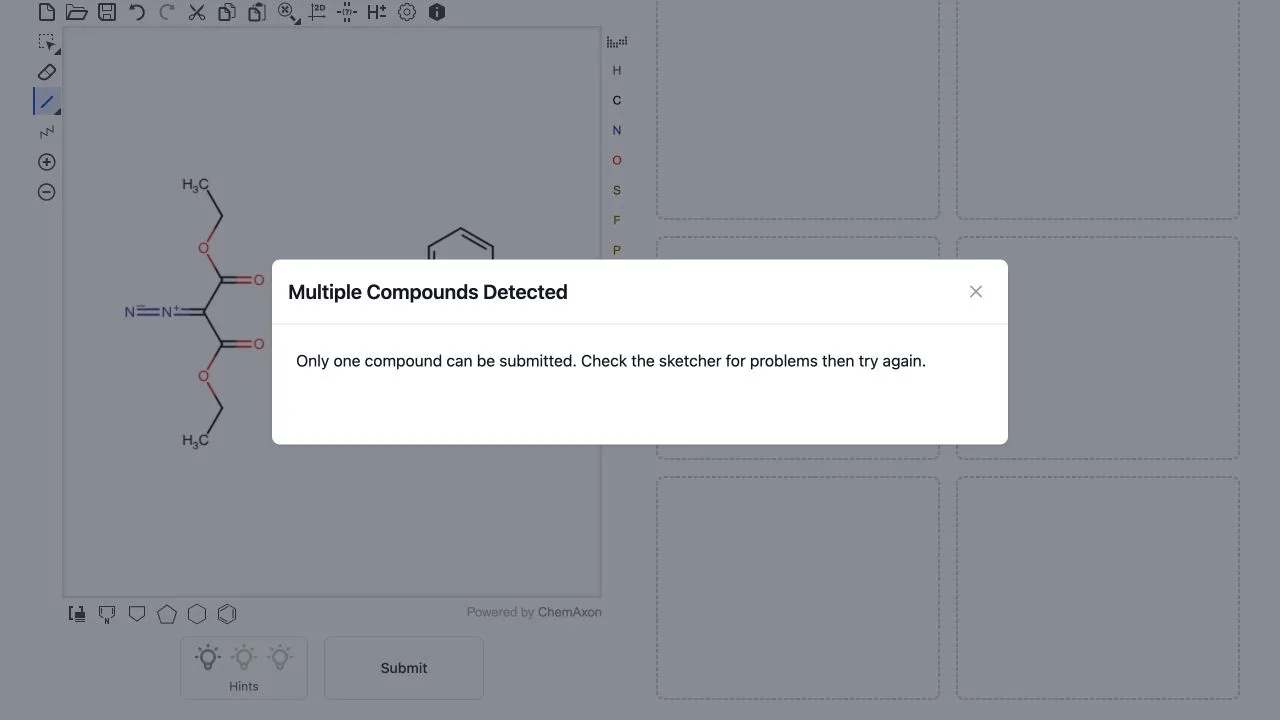
The editor contains tools for atoms, bonds and rings, plus import controls. Before a guess is scored, the page checks that it is a usable submission. Our first attempt retained multiple separate compounds and triggered “Multiple Compounds Detected,” with instructions to submit only one compound and check the sketcher.
Clearing the editor and submitting it empty produced “No Guess Detected.” These are input-validation messages, separate from the feedback for a valid but chemically wrong answer. A player needs to correct the drawing before those attempts can serve as useful reaction guesses.
We then used the editor's visible Import dialog to enter a simple benzene structure and replace the canvas content. That deliberately incorrect single-compound guess was accepted as a submission. Its structure appeared in the first attempt box with a red border. No answer source or hidden puzzle data was used.
Read the attempt colors carefully
The official How To Play instructions allow six attempts and describe red as incorrect, blue as an intermediate and green as correct. Our test directly confirmed the red feedback on an accepted wrong structure. We did not produce an intermediate or the correct product, so those other colors are documented rules rather than observed outcomes in this session.
The version notice also says atom and bond highlighting was removed because it could be misleading. Do not interpret a submitted red structure as if every individual bond carries a separate correctness hint. The visible feedback in our test applied to the submitted attempt.
Chemistry context comes before drawing
The site describes its daily problems as drawing on named reactions, drug syntheses and total synthesis transformations. The reaction conditions above the sketcher provide the context for deciding what product to draw. Our screenshot shows the scheme and one wrong attempt without revealing the daily product.
The page includes hints, an archive and account-related options. We did not use a hint, sign in or test paid features. The completed interaction was validation, correction to a single structure, submission and incorrect feedback; the chemistry problem itself remained unsolved.
FAQ about Chemdle
Why does Chemdle say Multiple Compounds Detected?
The submission contains more than one separate compound. The tested validation message requires one compound and asks you to check the sketcher before trying again.
What do Chemdle’s red, blue and green results mean?
The official instructions label red incorrect, blue an intermediate and green correct. Our test observed the red border after an accepted wrong structure.
How many attempts does Chemdle allow?
The official How To Play instructions give six attempts. Empty or multiple-compound submissions triggered validation messages during our test rather than a normal scored structure.
Player reviews
0 reviewsPlayed it? Share what you think and help the next player choose.
Your experience
Games like Chemdle
All science & nature games →
Stardle
Science & NatureFind a five-letter astronomy word or name in six guesses, using familiar letter feedback and a daily space theme.

Doggle
Science & NatureIdentify a dog’s breed from a photograph in five tries, or choose two breeds in Mixed mode.

Metaflora
Science & NatureFind a mystery plant through evolutionary relationships, with 25 guesses and hints that cost three guesses.

Elementle
Science & NatureIdentify the daily element in eight guesses using atomic-number arrows, chemical-symbol colours and family feedback. Daily play works without an account.

Birdle
Science & NatureIdentify a daily bird from photographs, using order, family and genus feedback; practice mode offers filtered multiple-choice questions.

Metazooa
Science & NatureUse shared ancestors to narrow a hidden animal, checking which tree branches belong to the target and which connect only your guesses.