
1 / 2
On this page
Caseboard puts 25 words in front of you and gives you a clue such as a category or association followed by a number. That number tells you how many related words you are looking for. Find all eight target words to clear the case, while avoiding the red herrings mixed into the board.
The interesting part is deciding which connection the clue intends. A word can look relevant through a broad association without belonging to the target set. You are trying to read the clue precisely enough to select the intended words and keep the final score low.
Read the number as part of the clue
The interactive tutorial starts with a short, concrete example. A clue for two fruit-related words lets you select a correct answer, see an ordinary mistake and encounter a red herring. It demonstrates the difference before you tackle the full board.
In a case, scan all 25 words before committing to the most obvious connection. The word portion of the clue suggests the link, while its number sets the size of that group. If you can explain why several candidates fit but need only a smaller set, compare their meanings more carefully rather than treating any loose connection as enough.
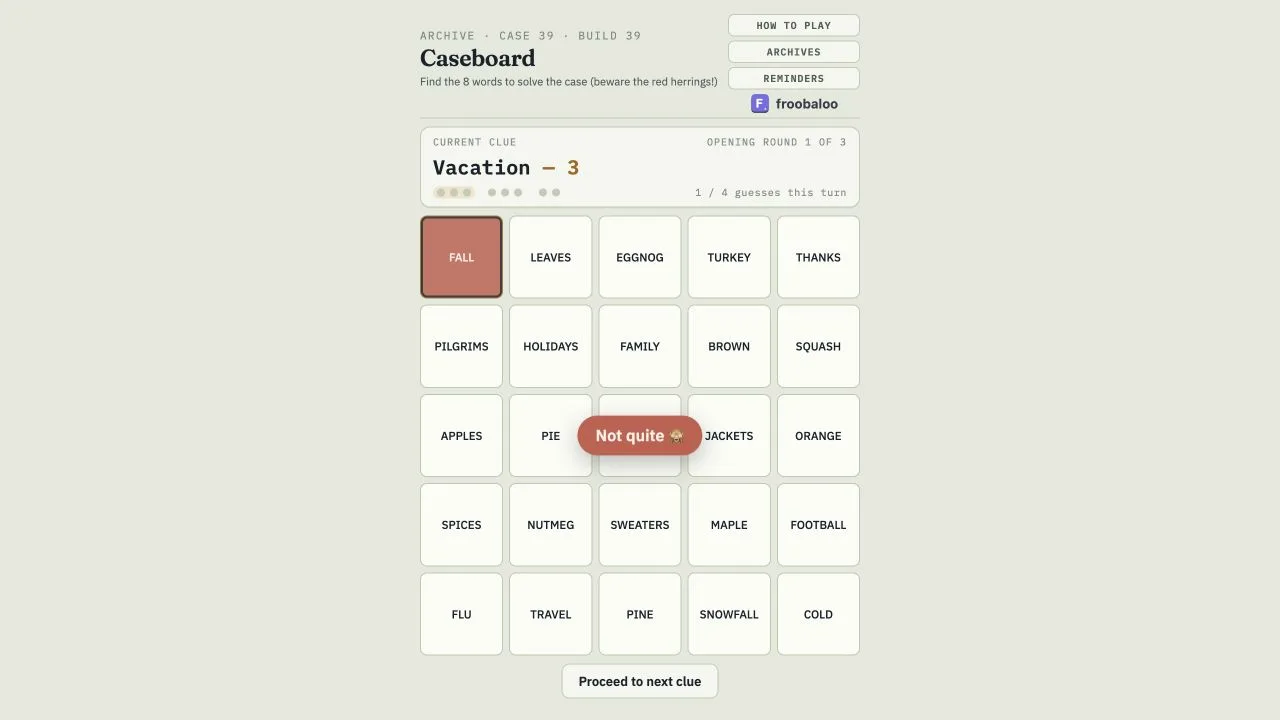
The main board preserves the clue above the tiles and tracks guesses within the turn. Selections receive visible feedback, so you can distinguish an accepted answer from a mistake. Our later archive check deliberately selected a wrong word and produced a red tile with a “Not quite” message. We then left that historical board unfinished.
Aim for fewer clues and penalties
Caseboard scores efficiency rather than awarding more points for extra guesses. The tutorial explains the total as clues used plus penalties: ordinary misses or skips add one, and red herrings add two. Lower is better. There are two red herrings among the board’s distractions, so a tempting wrong association can cost more than an ordinary mistake.
We completed the served daily case unaided after working through the tutorial. Its three opening clues covered the eight targets. The result showed three clues used, no ordinary misses, no red-herring mistakes and a final score of 3. No video or solution was consulted before the solve.
That is a result from one board, not a promise that every case will feel equally easy. Names, phrases and alternate meanings can make a connection less obvious. The score gives you a reason to pause and compare candidates before tapping: one extra guess may be less useful than recognising the intended relationship.
Older cases without streak pressure
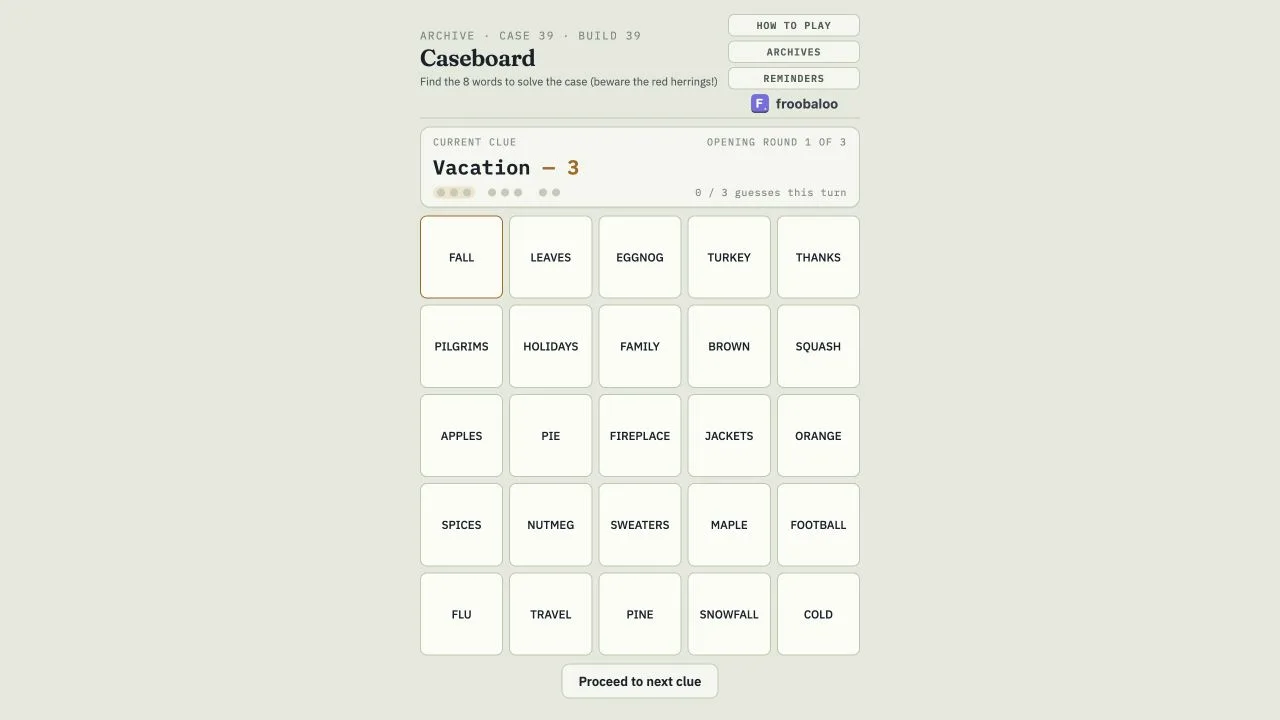
The Archives control opens a calendar of previous cases. We selected case 39 from November 1 and opened its first clue on a fresh board. The archive explicitly states that playing past cases does not affect the daily streak, making it a useful place to learn the clue style.
Our November 21 check was served case 58 labelled November 20. We report that visible date rather than assuming the game had already switched to a new local day. A precise reset timezone was not established during this session. Basic play and the archive entry opened without an account; a complete pricing policy was not verified.
The gallery uses that older case instead of the completed daily solution. It shows both the initial word board and ordinary wrong-answer feedback. Try to explain the clue-to-word connection before choosing each tile: Caseboard rewards a coherent set of associations more than quick tapping.
FAQ about Caseboard
Is a higher Caseboard score better?
No. The scoring explanation adds clues and penalties, so a lower total is better. Our clean three-clue solve finished with a score of 3.
What makes a red herring different from a normal miss?
The tutorial gives a red herring a two-point penalty, compared with one point for a normal miss or skip.
Will an archived case change my daily streak?
The archive states that archive plays do not affect your streak. We opened an older case from its calendar.
Player reviews
0 reviewsPlayed it? Share what you think and help the next player choose.
Your experience
Games like Caseboard
All word games →
Letter Tax
WordAnswer seven categories while permanently taxing letters out of later words, then weigh rescue help against leaderboard eligibility.

Decoys
WordChange one letter in every word to uncover a shared secret group. Decoys separates harmless typos from real-word slips and marks solves that use its single reveal.

sedecordle
WordSolve sixteen five-letter words with a shared stream of guesses and a 21-guess limit in the original Sedecordle mode.

Transfiguword
WordSolve three definition clues, bank their letters, then rearrange the full pool into two new answers and a mystery word.

Wordgy
WordJoin a chain of compound words and two-word phrases, with free direction changes and optional score-reducing help.

Wordsummit
WordTrace adjacent letters to find the highest-scoring word on a 5×5 board. Five attempts, tile multipliers and coloured feedback make each path a deduction.