
1 / 5
VideoOn this page
Bracket City turns a sentence into a stack of small word puzzles. Solve an exposed clue and its answer drops into the surrounding text, often creating the next clue inside a larger pair of brackets. The pleasure comes from seeing a messy passage gradually resolve into something readable.
How the brackets unfold
Ben Gross’s game on The Atlantic uses one Answer box for the whole board. You can enter a solution for any currently exposed clue; you do not have to work from left to right. Correct entries replace their brackets and appear in the Answer Bank. A short answer may become part of a longer word, so the meaning of a line can change substantially after just one submission.
Our completed November 12 puzzle mixed straightforward definitions with emoji, familiar phrases and fragments embedded inside other words. We could move to another exposed clue when one section stalled. That freedom helps, but it does not remove the dependency: an outer clue may only become readable after its inner brackets have been solved.
Think before clicking a clue
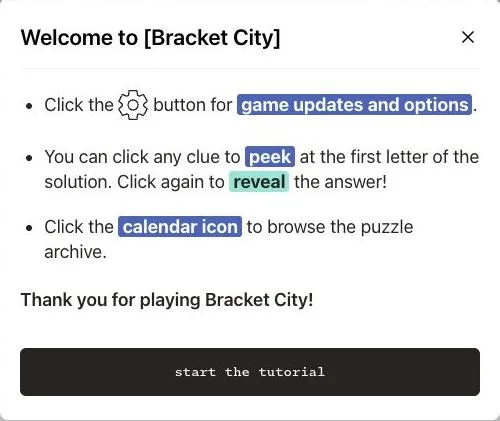
The highlighted clues are also assistance controls. The official welcome panel says that clicking a clue peeks at its first letter, and clicking again reveals its answer. Use the shared Answer box when you already have a guess; clicking the clue merely to select it can request help instead.
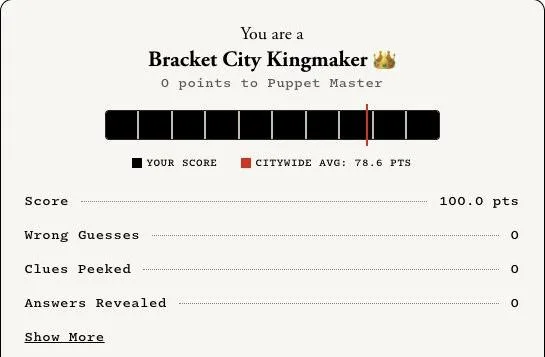
The result panel separates Wrong Guesses, Clues Peeked and Answers Revealed. We finished the November 12 puzzle with 100.0 points and all three counters at zero, earning the displayed Kingmaker rank. That is one observed result, rather than a formula for how every mistake or hint affects scoring.
A compact puzzle with shifting context
Bracket City suits players who enjoy short definitions but want more interaction between answers than a conventional clue list provides. The strongest moments are the transitions: a tiny definition disappears, a larger phrase suddenly makes sense, and the next layer opens. Emoji and incomplete word fragments also demand a different sort of reading from a regular crossword.
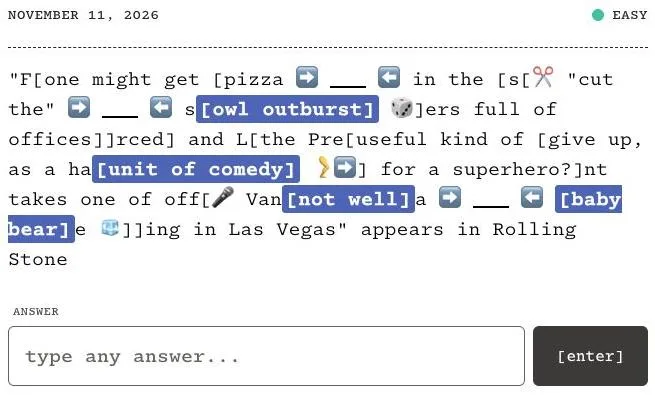
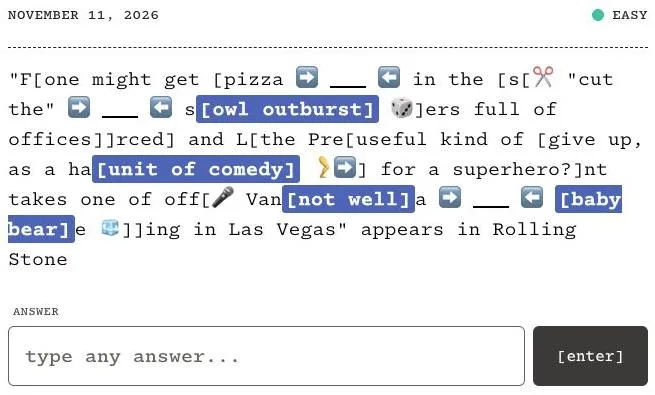
The dense opening passage can be harder to scan than the individual clues deserve. Start with an exposed clue you recognize, submit it in the Answer box, then reread the surrounding text instead of assuming it still means the same thing. The calendar provides access to the puzzle archive; we also opened the unsolved November 11 board after our completed run. The accompanying board screenshot shows that separate archived puzzle, while the result image keeps the solved sentence out of view.
FAQ about Bracket City
Does clicking a clue select it for an answer?
The official help says a click peeks at the first letter and a second click reveals the answer. Enter a guess in the shared Answer box instead.
Must the clues be solved from left to right?
No. We could enter any exposed clue in the same Answer box. Enclosing clues became readable as their inner brackets were replaced.
Can you open earlier puzzles?
The calendar opens the archive. After finishing the November 12 puzzle, we opened the unsolved November 11 board shown in our screenshot.
Player reviews
0 reviewsPlayed it? Share what you think and help the next player choose.
Your experience
Games like Bracket City
All word games →
Letter Tax
WordAnswer seven categories while permanently taxing letters out of later words, then weigh rescue help against leaderboard eligibility.

Decoys
WordChange one letter in every word to uncover a shared secret group. Decoys separates harmless typos from real-word slips and marks solves that use its single reveal.

sedecordle
WordSolve sixteen five-letter words with a shared stream of guesses and a 21-guess limit in the original Sedecordle mode.

Transfiguword
WordSolve three definition clues, bank their letters, then rearrange the full pool into two new answers and a mystery word.

Wordgy
WordJoin a chain of compound words and two-word phrases, with free direction changes and optional score-reducing help.

Wordsummit
WordTrace adjacent letters to find the highest-scoring word on a 5×5 board. Five attempts, tile multipliers and coloured feedback make each path a deduction.