
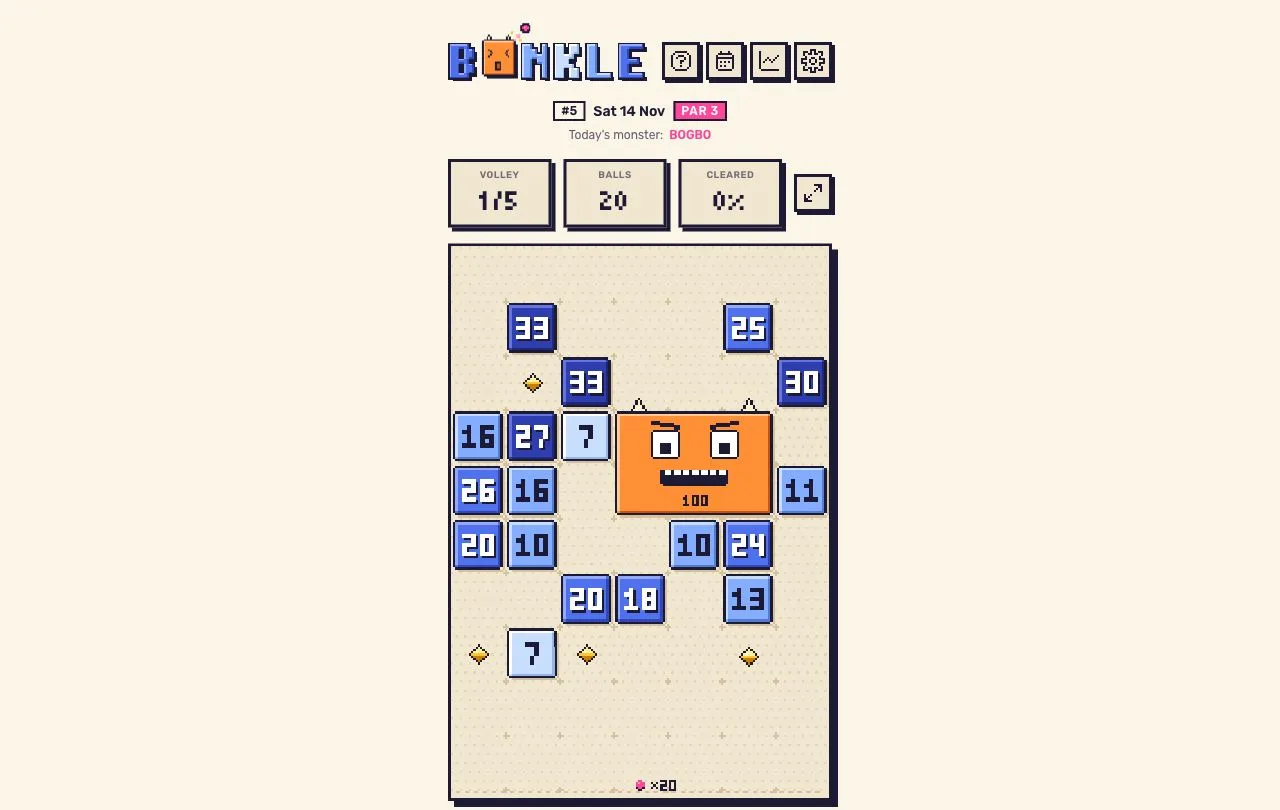
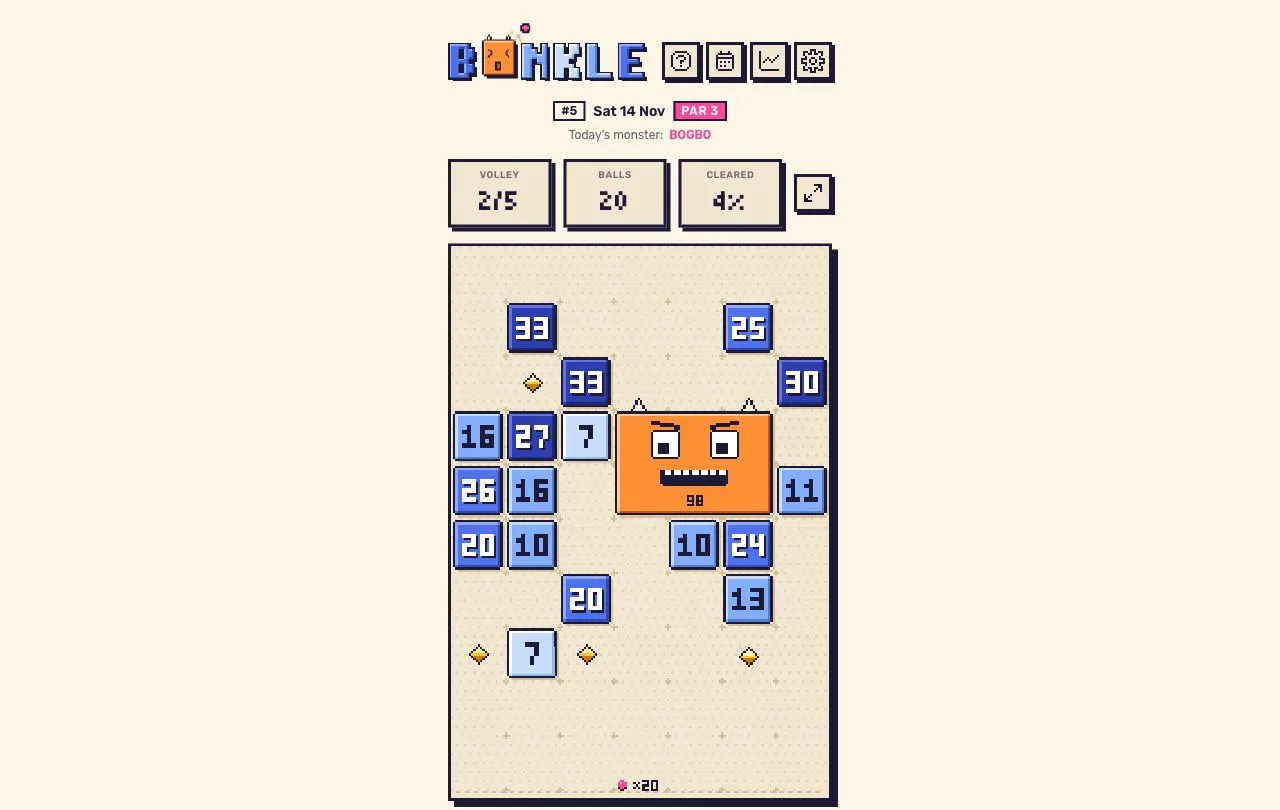
1 / 2
On this page
Bonkle gives you five volleys to break a daily board of numbered blocks, with a 100-HP monster occupying a large patch in the middle. A volley sends a whole stream of balls along the angle you choose. The decision is where to send that stream: into a nearby block, through a gap, or toward a gem that could improve later shots.
Everyone receives the same daily board and monster. You get three attempts at that board, and your best attempt becomes your score for the day. That leaves room to learn an angle from a failed run without turning the daily challenge into unlimited retries.
Aim the stream, then watch the rebounds
Drag on the board and release to fire. The keyboard alternative uses the left and right arrow keys to adjust the aim, with Space to show the aiming line and Space again to shoot. Each ball removes one hit point when it strikes a block, so a block's number tells you how many more hits it needs.
Aiming at the nearest target is easy to understand, but a line that reaches above the blocks can produce several rebounds. Bonkle's own instructions recommend getting balls into that upper space. The value of an angle depends on what the remaining layout lets the balls reach; one direct hit does not necessarily say much about the rest of the volley.
The counters above the board keep the limited resources visible: which of the five volleys you are using, how many balls are in the stream, and the percentage cleared. During our first complete attempt, that percentage climbed after each volley, but the final shot still left most of the board standing. The result panel recorded the cleared percentage, the monster's escape and the gems collected. That was a completed loss, rather than evidence of a full clear.
Gems and the monster change the priorities
Every gem you hit adds one ball to the next volley. An early gem therefore has more remaining volleys in which to help. Chasing one late in the run has less future value, so the timing matters alongside its position.
The monster is another substantial target. According to the official help, reducing its 100 HP to zero makes it explode, removing between 1 and 10 HP from every block touching it. We did not trigger that explosion in the completed test, so the damage range comes from the rules rather than an observed win. Its position still gives you a reason to consider the surrounding blocks when choosing a line.
Three attempts, with shots saved as you fire
The Try again control reset our cleared percentage to zero and returned the volley counter to 1/5 for attempt two. A subsequent shot changed both the numbered blocks and the progress counter, providing immediate feedback on the new attempt. Refreshing is not an undo method: the FAQ says each shot is saved as it is fired.
The board also displays a par of three or four volleys. The developer says a solver tests the boards before release, and only those with one of those par values are selected. Par describes a target for clearing the board; it does not reduce your five-volley allowance.
Bonkle is made by Ladle Games and is free without an account. Progress and statistics are saved in the browser. A new board arrives at midnight in your local time, while the calendar offers older boards with three attempts each. Those archived attempts do not contribute to statistics or a streak.
FAQ about Bonkle
Can refreshing undo a Bonkle shot?
No. The official FAQ says each shot is saved as you fire it. Your best of three attempts is used for the daily score.
Do archived Bonkle boards count toward a streak?
No. Older boards have three attempts each, but the FAQ excludes them from statistics and streaks.
Does par limit you to three or four volleys?
No. You still have five volleys. Par is the solver-tested target displayed for clearing that board.
Player reviews
0 reviewsPlayed it? Share what you think and help the next player choose.
Your experience
Games like Bonkle
All logic games →
Ponder Club
LogicA daily puzzle collection spanning words, numbers and visual games; tested here through Color Flood.

Ronin
LogicFill a 6×6 chess grid with one of each piece per region, keeping matching pieces out of attack. Use pencil notes and explore numbered past puzzles.

Nonograms
LogicFill black runs from row and column clues on 5x5 to 25x25 grids, request another standard puzzle, or choose scheduled special puzzles.
Guess a hidden word using totals for exact matches, misplaced letters and misses. Play a daily puzzle or choose a word length in Unlimited.

Boxed In
LogicFit nine supplied words into a shared letter grid, using the given letters and placement previews.

Unlabeled
LogicRestore eight missing axis labels across four charts, using numerical scales to separate the right labels from two decoys. Correct placements lock after each check.